Milwaukee Area Divide in Voting Is Unusually Deep, Gilbert and Franklin Say


It isn’t just that we disagree whether we prefer pepperoni or anchovies on our pizza. We disagree about what pepperoni and anchovies are. And we disagree in increasingly strong ways.

That’s one way that Charles Franklin, professor of law and public policy at Marquette University Law School, described the sharply partisan atmosphere of American politics. He spoke Thursday in the Appellate Courtroom of Eckstein Hall in the first session of the 2013-14 season of “On the Issues with Mike Gousha.”

Franklin and Craig Gilbert, Washington bureau chief of the Milwaukee Journal Sentinel, presented some of the early findings of research the two are conducting on polarization in politics, especially in the Milwaukee area and Wisconsin. Gilbert is on a six-month leave from the newspaper to take part in the project, supported by the Law School’s Sheldon B. Lubar Fund for Public Policy research.

Continue ReadingMilwaukee Area Divide in Voting Is Unusually Deep, Gilbert and Franklin Say

Milwaukee Arrests, Part IV: Racial Disparity Story Similar in Chicago, Sort Of

In the first post in this series, I explored the persistent racial disparities in Milwaukee arrests.  How does Chicago compare?  In a nutshell, the overall disparity rates are remarkably similar in Milwaukee and Chicago, but the War on Drugs drives the disparities to a much greater extent in the Windy City than here.

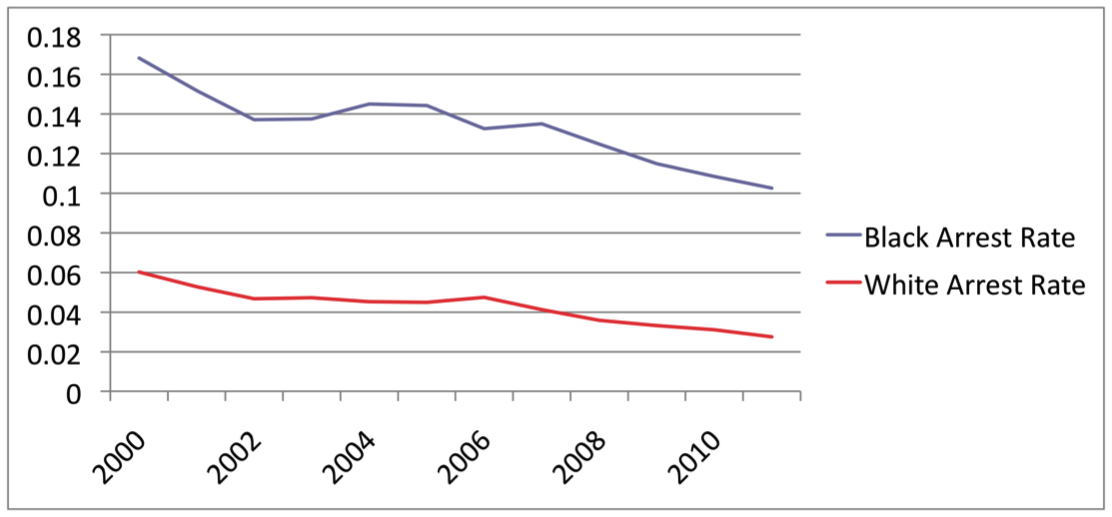
Let’s start by taking a look at black and white arrest rates in Chicago since 2000:

Chicago Arrests

As is apparent, arrest rates have been coming down for both races, but white rates remain well below black.

Here is what has been happening in Milwaukee during the same time period:  

Continue ReadingMilwaukee Arrests, Part IV: Racial Disparity Story Similar in Chicago, Sort Of

Murder and Milwaukee

Sunday on my statewide television show UpFront, I asked Milwaukee Police Chief Ed Flynn a simple question. Given the recent rash of shootings and homicides in Milwaukee, what would he say to out-state residents who might be wondering whether the city is safe?

“As long as they’re not coming here to engage in crime,” the Chief responded, “they’re safe.” Flynn said Milwaukee has one of the safest big-city downtowns in the country, but it also has a well-armed criminal community. According to the chief, 85 percent of Milwaukee’s victims and 95 percent of its offenders in gun-related cases have significant criminal records.

To address the spike in violent crime, Flynn and Mayor Tom Barrett asked the state to kick-in $500,000 for additional police overtime. But their suggestion didn’t get a warm reception from Assembly Speaker Robin Vos. In an interview with WisconsinEye’s Steve Walters, Vos criticized how city officials were running the department, and said the strategy to combat violence in Milwaukee isn’t working.

Nearly two dozen shootings in a week. Seven gun-related murders in seven days. The recent events have led to a fierce public debate. Was Milwaukee well on its way to becoming Detroit? Had police strategies to combat violent crime failed? Or was Milwaukee no different from many other big cities which have experienced similar spikes in crime?

Continue ReadingMurder and Milwaukee