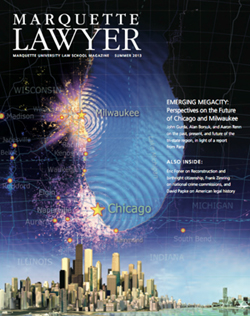
New Marquette Lawyer Magazine Focuses on Chicago and Milwaukee “Megacity”

Marquette LawyerProvocative essays on the future of Milwaukee in the emerging Chicago megacity lead the content of a packed and wide-ranging new edition of Marquette Lawyer, the Marquette University Law School semiannual magazine.

The megacity that stretches along Lake Michigan, from north of Milwaukee down through Chicago to northwestern Indiana, was the focus of a July 2012 conference at Marquette Law School, “Milwaukee’s Future in the Chicago Megacity.” The magazine includes two essays building on presentations at that conference: “Rivalry, Resignation, and Regionalization,” by historian John Gurda, and “Flying Too Close to the Sun?” by urban blogger and expert Aaron Renn. My own contribution is an overview of efforts to build cooperation in economic development in the tri-state region.

The magazine also presents “The Civil War, Reconstruction, and the Origins of Birthright Citizenship,” an essay by Columbia University historian Eric Foner based on his Boden Lecture at Marquette Law School last fall, and “The Accidental Crime Commission: Its Legacies and Lessons,” by Franklin E. Zimring, of the University of California, Berkeley’s law school, based on his Fall 2012 Barrock Lecture here.

Marquette Law Professor David Ray Papke gave a lecture in Uganda on the connection between the law and social power. “Exploring Socio-Legal Dominance in Context: An Approach to American Legal History,” based on his talk, is included in the new magazine.

The magazine also contains news of the Law School and of some of its students and alumni. The printed magazine is being sent to Law School students and alumni across the country and to many others. You can get a jump on reading this issue on the Law School’s website.

To read the interactive version of the magazine, click here.

To read specific articles and sections, click on any of these:

For all three pieces on the Chicago megacity, click here.

The individual pieces are available by clicking on each of these:

Emerging Megacity: Perspectives on the Future of Chicago and Milwaukee

Thinking and Acting (and Flourishing?) as a Region

Rivalry, Resignation, and Regionalization

Flying Too Close to the Sun? 

And you can click on each of these:

The Civil War, Reconstruction, and the Origins of Birthright Citizenship

The Accidental Crime Commission: Its Legacies and Lessons

Exploring Socio-Legal Dominance in Context: An Approach to American Legal History

Law School News

Remarks of Dean Joseph D. Kearney at the Investiture of Circuit Judge Lindsey Grady

From the Dean

Alumni Class Notes

Alumni Awards


Continue ReadingNew Marquette Lawyer Magazine Focuses on Chicago and Milwaukee “Megacity”

The Mayor and His Map

The next time you see Milwaukee Mayor Tom Barrett, ask him about his map. It’s the Mayor’s latest weapon in his battle to stop the state from eliminating residency requirements for municipal employees in Wisconsin. More than 120 municipalities have rules spelling out where their employees can live. But Governor Walker wants to change that. He says residency requirements are unnecessary and outdated, even counter-productive, and he has included language in his state budget that would end them.

Mayor Barrett says the Governor’s proposal doesn’t belong in the budget, since it’s not a fiscal item. But Barrett’s concerns go much deeper. In a recent e-mail to supporters, Barrett said an end to the city’s 75-year-old residency requirement could “destabilize” Milwaukee. I pressed the Mayor on that claim in a recent television interview. He said philosophically he agrees with the notion that people should be able to live where they want, but that local municipalities should be able to determine the conditions of employment for the people they hire. In Barrett’s world, that translates into a simple reality. If you don’t want to live in Milwaukee, don’t apply for a job with the city. He said there’s been no shortage of applicants.

Perhaps more important, Barrett said the value of assessed property in Milwaukee had fallen five billion dollars because of the economic downturn. He argued that based on experiences in other cities, such as Detroit, Minneapolis, Baltimore, and Cleveland, significant numbers of city employees were likely to leave the city should the residency requirement be lifted. Barrett was making the case that there was great risk to his city, and he wanted to show me a map he carried with him into the television studio. You can see it here. Because of the amount of data in the file, it takes about 10-15 seconds to present itself.

The map shows the gravity of Milwaukee’s foreclosure crisis. Foreclosed properties are in red. As of last week, there were nearly 2600. Blue represents where the more than 7,000 city employees live. Besides helping stabilize struggling sections of Milwaukee, city employees are the backbone of a number of healthy, middle-class neighborhoods, including Bay View and the southwest, far south, and far west sides. These neighborhoods are home to hundreds of police officers and firefighters. But what happens if, as the Mayor believes, 40 to 50 per cent of those blue dots—city employees—move outside the city? Will there be a dramatic downward pressure on property values?

The Mayor contends the end of residency was a promise Governor Walker made to the Milwaukee police and firefighters unions in an effort to gain their support during his bid for Governor. Walker argues that personal freedom should trump conditions of employment, and that at the end of the day, it’s up to the city to become a more attractive place to live. Neither man knows exactly what will happen should the requirement be eliminated. Nor do they know what Mayor Barrett’s map will look like 10 years from now. But if Barrett is right, it will be a lot less blue, and Milwaukee could be a very different city.


Continue ReadingThe Mayor and His Map

Wisconsin #1 in Black Incarceration; How Did We Get Here?

new report from the UWM Employment and Training Institute shows that Wisconsin leads the nation in incarcerating black males.  Based on data from the 2010 U.S. census, Wisconsin incarcerates about one in every eight of its black men between the ages of 18 and 64.  This includes individuals held in state and local correctional facilities.  The Badger State’s black incarceration rate is, in fact, about one-third higher than that of the second-place state, Oklahoma, and nearly double the national average.

Wisconsin also leads the nation in incarcerating Native-American males, but its white-male incarceration rate (one-tenth of the black rate) closely tracks the national average.  Wisconsin’s Hispanic incarceration rate is actually below the national average.

The Milwaukee County data are particularly striking: more than half of the County’s black males between the ages of 30 and 44 have been or currently are housed in a state correctional institution.

Is this a recent phenomenon?  I’ve taken a look at some historical data on racial disparities for my three-states research.  The following graph indicates that Wisconsin has been above Indiana and Minnesota for some time in black imprisonment (that is, prisoners per 100,000 residents), but that the current wide gap did not really open up until after 1990: 

Continue ReadingWisconsin #1 in Black Incarceration; How Did We Get Here?