
Noted Historian and Milwaukee Native Kenneth Stampp Passes Away
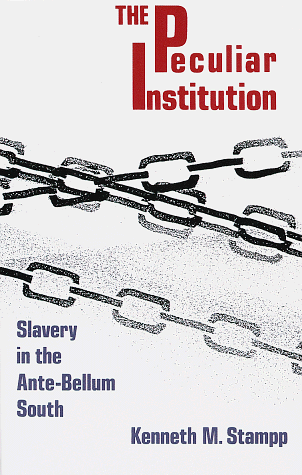 For the second time in recent weeks, a major Civil War era historian whose work was enormously important for American legal and constitutional history has passed away. Kenneth Stampp, Professor Emeritus of History at the University of California-Berkeley, died this past Friday at age 96, less than two months after the death of Harvard’s David Herbert Donald.
Stampp’s 1956 work, The Peculiar Institution: Slavery in the Antebellum South, revolutionized the study of American negro slavery, once and for all dismissing suggestions that the institution was fundamentally benign or that African-Americans quietly acquiesced in their slave status. No book did more to demolish the moonlight and magnolias view of antebellum southern history.
His 1965 work, The Era of Reconstruction, 1865-1877, destroyed the myth that white Southerners were the primary “victims” of the Reconstruction years. This work was among the first to link the Reconstruction period to the modern civil rights movement, which was very much underway during the time that Stampp wrote.
Stampp was also the author of numerous other historical works, including And the War Came: The North and the Secession Crisis (1950) and America in 1857: A Nation on the Brink (1990). Over the course of his long career, he won most of the major awards available to American historians. He was also instrumental in the training of a generation of Southern and Civil War era historians whose own work built upon the insights of their mentor. His former students include such historical luminaries as William Freehling, Leon Litwak, James Oakes, Joel Williamson, William Gienapp, John Sproat, Robert Starobin, Robert Abzug, and Reid Mitchell.
What is less well known is that Kenneth Stampp was a native of Milwaukee. He was born in the Cream City on July 12, 1912, the son of Oscar Stampp, a naprapath (chiropractor), and Eleanor Schmidt Stampp, a homemaker. While his parents were native-born Americans, his grandparents were all born in Germany or Switzerland, and Stampp grew up in a Protestant neighborhood on the north side of Milwaukee where German was spoken as frequently as English, at least until the onset of U. S. involvement in the First World War.
Stampp attended Washington High School, from which he graduated in 1931 during the depths of the Great Depression. He began college at Milwaukee State Teachers College (now UWM), but left abruptly in 1933 when one of his professors sought to discourage him from continuing to pursue his goal of becoming a high school history teacher. (The professor thought that Stampp should pursue a career in elementary education.)
After withdrawing from Milwaukee State, Stampp’s German Methodist father suggested that he enroll in Marquette University instead. As Stampp later recounted, “My father said, ‘Well, would you like to go to Marquette University?’ I said, ‘I’m not going to that Catholic institution.’ I have to tell you another thing: there was a lot of anti-Catholicism in my family because of their kind of Protestantism. My father had been very anti-Catholic, so I had no trouble saying, “Look, I’m not going to that Catholic college.”
After briefly considering enrolling in Waukesha’s Carroll College, Stampp instead enrolled at the University of Wisconsin-Madison, from which he received his B.A. (1935), M.A. (1936), and Ph.D. (1942) degrees in history. His first teaching positions were at the University of Arkansas and the University of Maryland. He joined the faculty of the University of California in 1946 and remained there until his retirement in 1983, except for stints as a visiting professor at Harvard, Oxford, the University of London, and the University of Munich.
A full transcript of Stampp’s 1998 oral autobiography, which includes the story regarding his boyhood in Milwaukee and his decision not to attend Marquette University, can be found online here.
 Each May the