New Marquette Lawyer Sheds Light on Urban Neighborhoods—and Much More

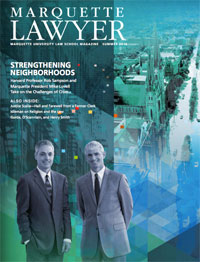
Marquette LawyerPair up the wisdom of a leading national expert on understanding urban neighborhoods with an effort to increase the vitality of a large section of Milwaukee’s west side and what do you have? You have the cover package of the Summer 2016 issue of Marquette Lawyer magazine.

Professor Robert J. Sampson, the Henry J. Ford II Professor of Social Sciences at Harvard University, delivered the Robert F. Boden Lecture at Marquette Law School in September 2015, drawing on his work in Chicago and Boston examining the fabric of urban neighborhoods. ”Neighborhood Inequality and Public Policy: What Can Milwaukee Learn from Chicago and Boston?” offers an essay version of Sampson’s lecture, along with reactions from several Milwaukee leaders.

A partner piece describes efforts by Marquette University and other major institutions to improve housing, business and commercial life, safety, and community amenities in near west side areas of Milwaukee—generally between the Marquette campus and the Harley-Davidson offices and factory a couple miles to the northwest. “Writing a New West Side Story” describes the ambitious undertaking under the leadership of Marquette’s President Michael R. Lovell.  The piece concludes with a comment by Provost Daniel J. Myers.

The cover package also includes a reflection by Mike Gousha, distinguished fellow in law and public policy, on the Law School’s public policy initiative, which aims to increase dialogue about major issues and shed light on subjects such as what can help urban neighborhoods. The dean’s column at the beginning of the magazine also speaks to Milwaukee, urban America, and the Law School’s interest in these matters. 

Continue ReadingNew Marquette Lawyer Sheds Light on Urban Neighborhoods—and Much More

Opposing Views, One Conversation at Session on Milwaukee Education

Until Tuesday, Dale Kooyenga and Lauren Baker had never met. That alone is an argument for why their discussion before a capacity audience in the Appellate Courtroom of Eckstein Hall was worthwhile.

Kooyenga is a member of the state Assembly, a leader among Republicans pushing for education policies that embrace school choice, and a key figure behind a controversial new law that gives Milwaukee County Executive Chris Abele powers to control what happens in some low-success Milwaukee public schools.

Baker is the executive director of the Milwaukee Teachers’ Education Association, the union that is an influential force in Milwaukee politics and MPS decision making. The union opposes almost all the plans Kooyenga supports.

Never the twain shall agree? That’s likely, given the adamancy of their positions. But never the twain shall meet? That ended at the Law School event, which was titled “The Future of Education in Milwaukee: One Conversation, Two Viewpoints.”

Continue ReadingOpposing Views, One Conversation at Session on Milwaukee Education

Author Says Urban Progress Requires “Durable” Policy

A few phrases provide a taste of the serious serving of thoughts about urban centers in America offered by Patrick Sharkey, a sociology professor at New York University, at an “On the Issues with Mike Gousha” program at Marquette Law School on Tuesday.

“Multi-generational cumulative exposure.” Sharkey is author of the book, Stuck in Place: Urban Neighborhoods and the End of Progress Toward Racial Equality, and is working currently on issues related to violence and low-income communities. A key to his findings is that the problems facing people who live in poor, predominantly minority areas have built up for generations and show themselves in multiple serious ways, including the educational success and future prospects of children.

“A durable urban policy agenda.” Sharkey said that one thing that has shown positive results is sustained effort to help people with housing, jobs, education, and other matters – with the emphasis on the word “sustained.” So many initiatives are launched and then dropped, he said. He said he doesn’t see durable policy coming from the federal government. The waning of such efforts after the late 1960s is one of the main reasons progress in closing racial gaps stopped, he said. But durable efforts have been undertaken on more local levels, and that gives him some cause for optimism.

Continue ReadingAuthor Says Urban Progress Requires “Durable” Policy