SCOTUS Weighs in on Forced Blood Draws in DUI Cases

In the wake of today’s decision by the U.S. Supreme Court in Missouri v. McNeely, DUI defense attorneys across the land are doing the “happy dance.”  Prosecutors (both state and federal) on the other hand are rending their garments and hair trying to figure out how to deal with the high court’s ruling that forced blood draws in most DUI cases will now require warrants, and the flood of “refusals” sure to follow as the implications of the case filter out to the public.

Wisconsin’s approach, first established in 1993 in State v. Bohling and then reinforced in 2004 in State v. Faust had been to allow warrantless blood draws in drunk driving cases after several criteria were met, including the presence of  probable cause for the officer to believe the driver under investigation had indeed been driving under the influence of alcohol. The key factor that drove the Wisconsin interpretation was the fact that the blood alcohol level of a drunk driving suspect is continually shifting and dissipating from the time the driver is apprehended, and the extra time it takes to procure a warrant incontrovertibly causes BAC evidence to be lost.

Wisconsin’s rationale had recently served as a kind of dividing line in the national debate about warrantless blood draws. 
Continue ReadingSCOTUS Weighs in on Forced Blood Draws in DUI Cases

Does Federal Law Actually Preempt Relaxed State Marijuana Laws?

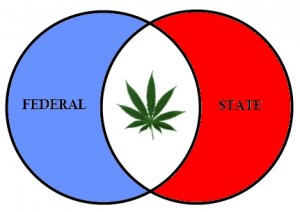
Federalism & MarijuanaThe Cato Institute’s Ilya Shapiro recently spoke at the Law School concerning the status of relaxed state marijuana laws in light of the federal Controlled Substances Act’s continued prohibition of activities that these state laws now allow. This is a timely question with, it turns out, a less-than-certain answer. More precisely, it demands an answer that is more nuanced, and less categorical, than one might initially be inclined to give.

One’s initial answer is likely that these state laws are preempted—that is, rendered void and unenforceable—because of the federal statute. It is conventional constitutional doctrine, after all, that the U.S. Constitution’s Supremacy Clause makes valid federal law supreme over conflicting state law. Moreover, because the U.S. Supreme Court in Gonzales v. Raich (2005) deemed the federal marijuana prohibition to be a valid exercise of Congress’ commerce power, the specific question of whether state marijuana laws are vulnerable to preemption seems already to have been answered.

Mr. Shapiro makes an important observation, however.

Continue ReadingDoes Federal Law Actually Preempt Relaxed State Marijuana Laws?

Tale of Three States: Minnesota’s Surprisingly Large Supervised Population

As noted here a few weeks ago, my forthcoming article comparing imprisonment trends in Indiana, Minnesota, and Wisconsin in now available on-line.  Due to space constraints, I was unable to include in the article all of the interesting data I have collected on the three states.  I’ll present some of that additional material in an occasional series of posts here.

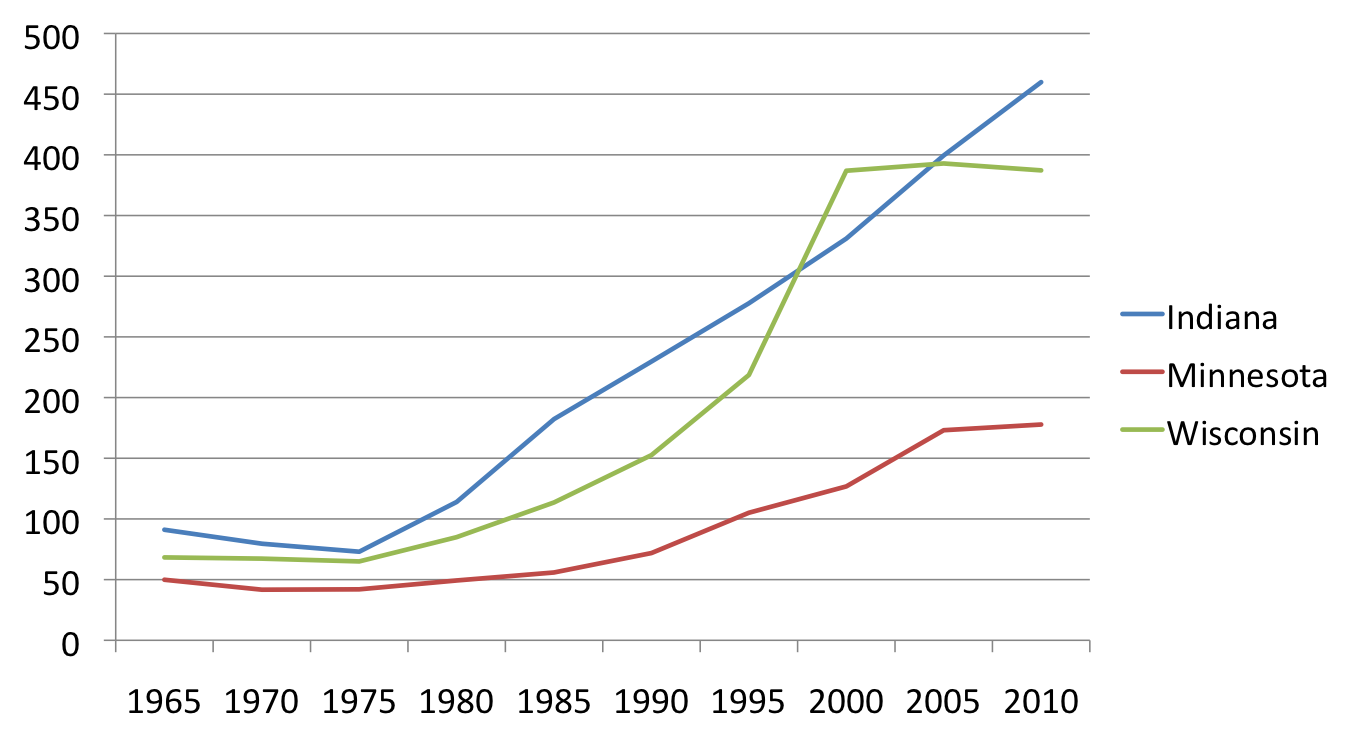
Today, let’s take a look at the supervised populations of the three states.  The supervised population is comprised of four subgroups: those in prisons, those in jails, those on probation, and those out on post-imprisonment supervised release (a status that goes by different names in different jurisdictions, but which I will call parole).  As is well known, Minnesota has a remarkably low imprisonment rate (at least by U.S. standards), although all three states have experienced an  imprisonment boom since the 1970s.  Here are the imprisonment numbers, reflecting the number of prisoners per 100,000 state residents: 

imprisonment numbers


As the graph indicates, Minnesota has maintained a consistently lower imprisonment rate than the other two states since the mid-1960s.  Indeed, the Minnesota advantage has tended to widen over time.  By contrast, Indiana has generally had the highest imprisonment rate, although Wisconsin has been close at times, and even took the lead for a few years.

The story is quite different, however, if you consider the supervision numbers more broadly. 

Continue ReadingTale of Three States: Minnesota’s Surprisingly Large Supervised Population