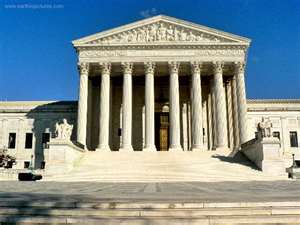
 In response to my earlier post about Chief Justices of the United States Supreme Court who were also the Court’s senior justice in terms of years of service, Nick Zales posed the question as to whether the late William Rehnquist was the only Chief Justice to have had no prior judicial experience before becoming a member of the Supreme Court. (While Rehnquist had served for 13 years as an Associate Justice of the Supreme Court before being elevated to the Chief position, that was his only prior judicial experience.)
As it turns out, Rehnquist shared a lack of prior judicial experience with a majority of the men who have held the nation’s highest judicial office. Altogether, nine, or slightly more than half, of the 17 men who have held the position of Chief Justice were appointed without prior judicial experience.
Moreover, of the eight who had previously been judges, several had very limited judicial experience. Edward White, for example, had served for only a single year on a state court, and that had been fourteen years prior to his appointment to the United States Supreme Court. The judicial service of the first Chief Justice, John Jay, constituted two years as the Chief Justice of the New York Supreme Court a decade before his appointment as the U. S. Supreme Court. The current Chief Justice, John Roberts, served for only two years and three months as a federal judge before his elevation to the Supreme Court in 2005.
While prior judicial experience appears to have become a prerequisite for a Supreme Court appointment in our own time, historically, there clearly was no such requirement. None of the men appointed Chief Justice in the 19th century (Marshall, Taney, Chase, Waite, and Fuller) possessed any prior judicial experience, and only four of the eight appointed in the 20th century (White, Taft, Vinson, and Burger) had previously served as judges at any level below the Supreme Court.
Moreover, other than the three who were promoted from the ranks of Associate Justices (White, Stone, and Rehnquist), only three Chief Justices (Rutledge, Burger, and Roberts) were sitting judges at the time that they were appointed Chief Justice, and one of them, John Rutledge, had his appointment rejected by the Senate, requiring him to step down after less than six months in office.
Several of the best known Chief Justices—John Marshall, Roger Taney, Charles Evans Hughes, and Earl Warren—had no prior judicial experience at all before their appointment to the Supreme Court, but this lack of time on the bench did not work to deny them entry into the pantheon of great Supreme Court justices.
The following chart summarizes the prior judicial experiences, or lack thereof, of the 17 Chief Justices.
John Jay (1789-1795) –former Chief Justice of the New York Supreme Court.
John Rutledge (1795-1975)—member of the South Carolina Court of Chancery, the South Carolina Court of Pleas, and prior service on the United States Supreme Court.
Oliver Ellsworth (1796-1800) – member of the Connecticut Superior Court.
John Marshall (1801-1835) – no prior judicial experience.
Roger Taney (1835-1864) – no prior judicial experience.
Salmon Chase (1864-1873) – no prior judicial experience.
Morrison Waite (1974-1888) – no prior judicial experience (declined appt. to the Ohio Supreme Court).
Melville Fuller (1888-1910) – no prior judicial experience.
Edward White (1910-1921) – served one year on the Louisiana Supreme Court before being appointed an Associate Justice of the United States Supreme Court in 1894.
William Howard Taft (1921-1930) – member of the Ohio Superior Court and the U.S. Sixth Circuit Court of Appeals, in addition to a four-year stint as President of the United States.
Charles Evans Hughes (1930-1941) – no prior judicial experience before his appointment to the Supreme Court in 1910. Resigned to run for President of the United States in 1916. Reappointed, 1930.
Harlan Fiske Stone (1941-1945) – no prior judicial experience.
Fred Vinson (1946-1953) – served on the United States Circuit Court for the District of Columbia.
Earl Warren (1953-1969) – no prior judicial experience.
Warren Burger (1969-1986) – served on the United States Circuit Court of Appeals for the District of Columbia.
William Rehnquist (1986-2005) – no prior judicial experience other than years as Associate Justice.
John Roberts (2005- ) — served on the United States Circuit Court of Appeals for the District of Columbia.

 This is the fourth in a series of posts addressing commonly asked questions regarding American Indians, Indian Tribes, and the law. The first post dealt with casinos, taxation, and hunting and fishing rights; the second focused on the relationship between the unique legal treatment of Indian tribes or their members and the U.S. Constitution’s guarantee of equal protection; and the third explored the criminal jurisdiction of tribes. This post will examine the civil jurisdiction of tribes, both over members and especially over non-members, in each its three major forms: regulation, taxation, and adjudication.
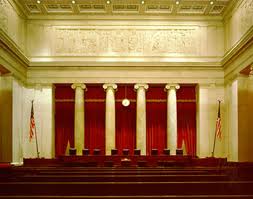 Wisconsin, like a number of states, designates the senior member of its state supreme court in terms of service as the Chief Justice. The United States Supreme Court, in contrast, uses a system in which the President of the United States chooses a new Chief Justice every time the existing Chief dies or steps down.