The Face of the Case: Obergefell Tells How He Became Part of Legal History

James Obergefell grew up in a blue collar, Catholic family in Sandusky, Ohio, got an undergraduate degree from the University of Cincinnati, and became a high school teacher.

“I was deep in the closet,” he said as he told his story during a program Wednesday, Sept. 18, 2024, in the Lubar Center at Marquette Law School. He came out in the early 1990s while he was in graduate school and met John Arthur. Within a short time, they considered themselves married. Legally, they were not – at the time, same sex marriage was not legal anywhere in the United States. But beginning in the mid -990s, they decided they wanted “marriage and everything that came with it,” as Obergefell put it.

Obergefell told Derek Mosley. executive director of the Law School’s Lubar Center for Public Policy Research and Civic Education, who moderated the conversation before a capacity audience of more than 200. how the legal landscape began to change, including a US Supreme Court decision in 2013 that struck down a federal law known as the Defense of Marriage Act. During the same period, Arthur’s health declined sharply after being he was diagnosed with ALS in 2012.

After the Supreme Court decision, Obergefell and Arthur decided to get married. Because Arthur’s health was so precarious, they needed to act quickly. And because legalities involving marriage varied across the country, they ended up taking a medical ambulance flight to the Baltimore/Washington airport in Maryland, where they could have a ceremony without ever getting off the airplane. Three months later, Arthur died.

What emerged from their marriage was a court case focused on whether Obergefell was the surviving spouse legally. And that case was joined with similar cases that ended up before the US Supreme Court, resulting in the landmark decision of Obergefell v. Hodges in 2015 which made same sex marriage legal throughout the United States. Obergefell recounted the events of the day the Supreme Court decision was issued. “I burst into tears” in the courtroom, he said. “For the first time in my life as an out gay man, I felt like an equal American,” he said. The audience applauded when he said that.   

Obergefell’s name became a big part of American legal history. And Obergefell himself moved from being a person of no prominence and no notable involvement as an activist into a continuing spotlight. It made him, as Mosley put it at the Law School program, “the face of the case,” someone who continues to be an advocate for rights of many kinds and someone who tells his personal story openly and with impact. Obergefell said he has realized how “stories matter — stories can change hearts and minds.”

“Going through something like this has a profound impact,” Obergefell told the audience. “It changes you.”

Obergefell said he is still motivated by anger over things he sees as wrong and the need to advocate for the rights of people facing many different situations. He also has less intense involvements, such as co-owning a wine label that has raised more than $250,000 for causes supported by him and the co-owner.

“Nothing makes me happier than to know that young people today are growing up in a world where the question of their right, their ability, to get married and have that relationship recognized is there.” Obergefell said.  “I had the absolute honor and privilege of being part of making things better for people younger than I am.”

Video of the one-hour program may be viewed by clicking below.
Continue ReadingThe Face of the Case: Obergefell Tells How He Became Part of Legal History

The 2024 Wisconsin Assembly Races are the Most Contested in a Decade

This post was updated on July 25th to add 3 contested GOP Assembly primaries.

The state legislative districts Wisconsin adopted in February 2024 bear little resemblance to the maps used previously.

As I wrote at the time, the new map is more competitive: there are more seats either party could win, and those seats will determine who controls both chambers. It is also more contested. The number of districts drawing a candidate from both parties, and the number of party primaries drawing multiple candidates are both unusually high.

The contested nature of the new districts is the subject of this blog post.

Voters in 82 Assembly districts (out of 99) will be able to choose between a Democrat and a Republican in November 2024. That is the highest number since at least 2010. In 2022, just 73 districts featured a candidate from both major parties.

The situation in the State Senate is different. Only 11 (of 16) races offer both a Democrat and a Republican. That is down from 12 (out of 17) in 2022.

Seats contested by both parties
Wisconsin State Legislature
assemblysenate
20106815
20127210
20144714
2016508
20186113
20207911
20227312
20248211

Under the new map, many legislators found themselves living in new districts—sometimes along with other sitting incumbents. This big shakeup creates a lot of opportunities for contested primaries.

To see how this primary season compares to past years, I collected the election results from each August partisan primary beginning in 2012. Here are the results.

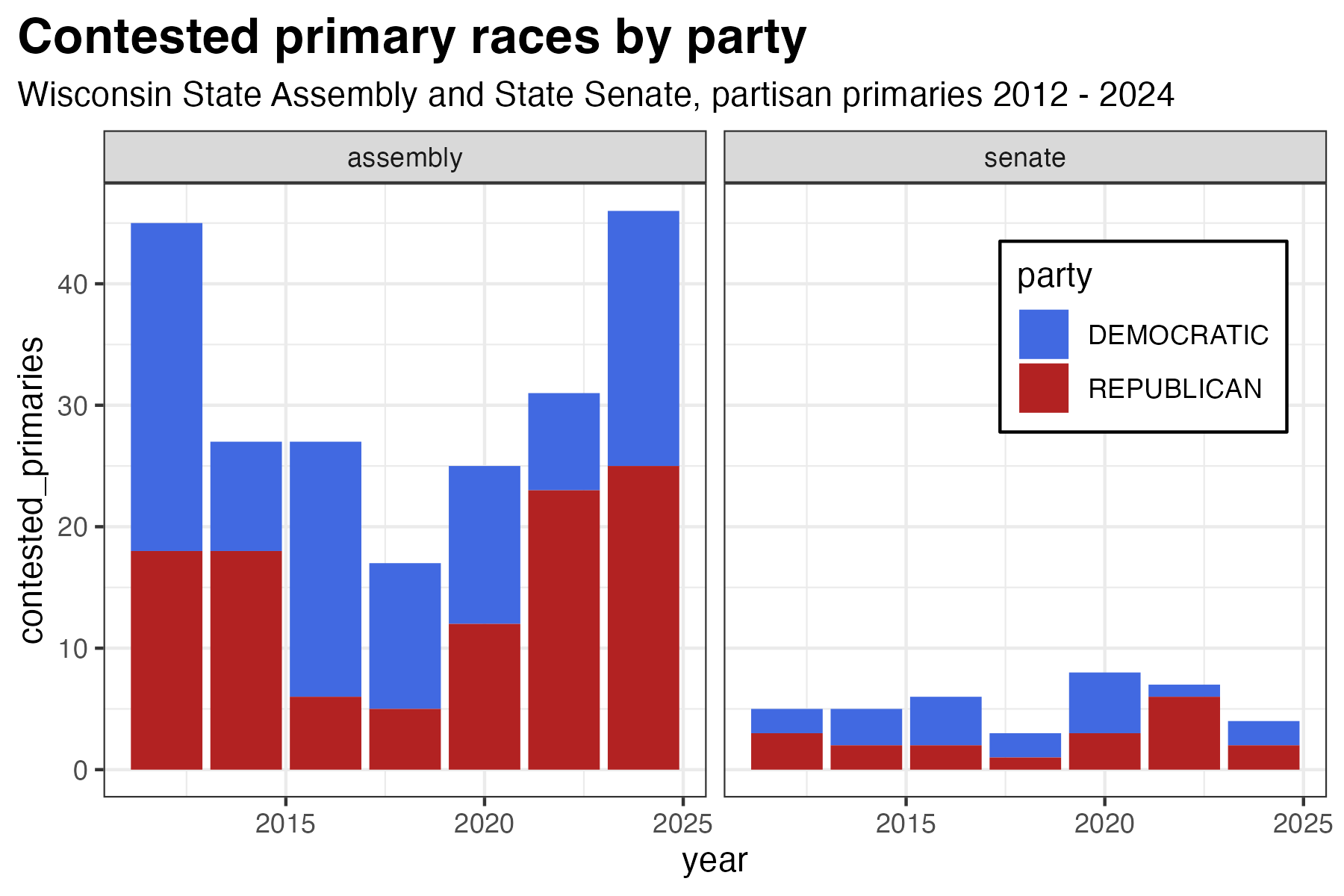
Given that there are 99 Assembly districts, there can be a total of 198 Democratic or Republican contested primaries. In 2024, there will be 46, up from 31 in 2022, 25 in 2020, and 17 in 2018. The last time we saw more contested primaries was 2012, when 45 featured at least two candidates.

The number of contested Republican primaries in 2024 is 2 more than in 2022. But the number of contested Democratic primaries grew from 8 in 2022 to 21 in 2024.

Fewer State Senate races feature competitive primaries. Out of 16 seats (32 potential primaries), only 4 are contested, 2 for each party. This is down from 7 in 2022 and 8 in 2020.

bar plot showing the number of primary races contested by each party in the WI state legislature

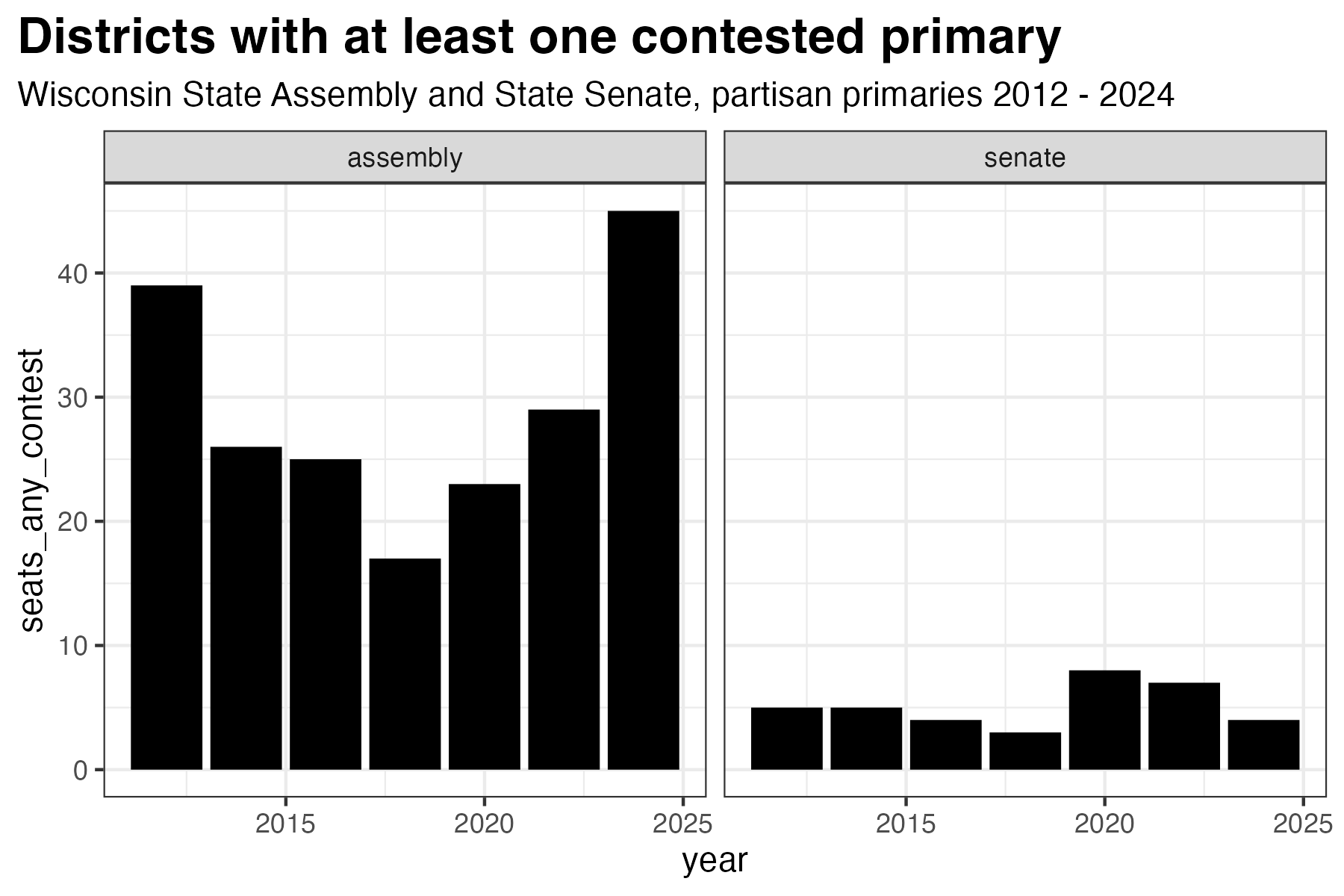
Most Wisconsinites live in a district that leans quite strongly toward one party or the other, so the partisan primary is often the most consequential state legislative race available to these voters. I was curious how many districts feature a contested primary from either party.

By this measure, 2024 is record setting, at least since 2012. Forty-five districts offer at least one contested Assembly primary. The next highest year is 2012, when 39 districts did so.

About 60,000 people live in each district, so roughly 960,000 more Wisconsin residents live in a district with a competitive primary in 2024 than two years ago. Compared to 2018, 1.68 million more Wisconsinites live somewhere with a contested Assembly primary.

bar plot showing the number of districts with at least one contested partisan primary in the wisconsin state legislature

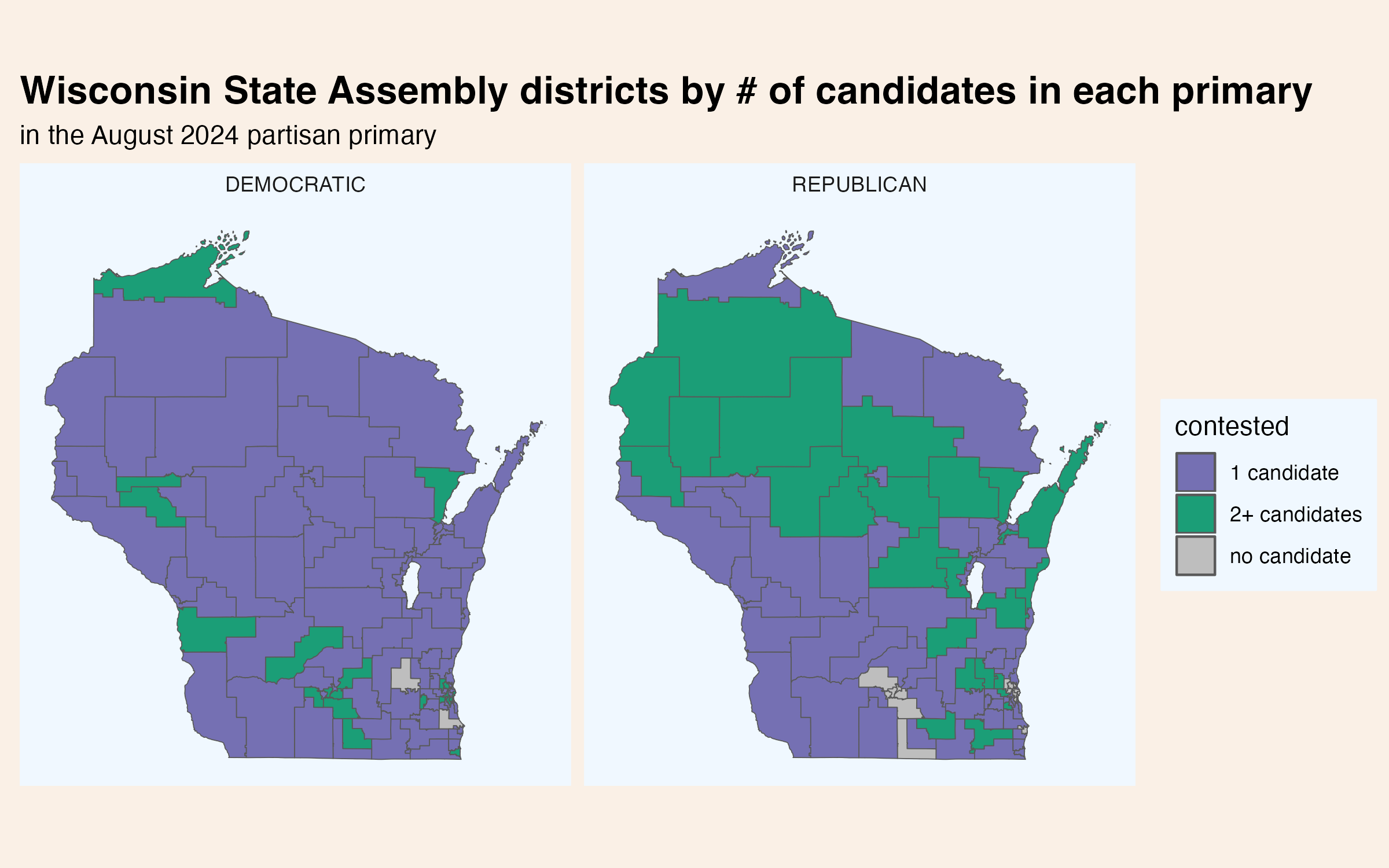
Of the 21 contested Democratic primaries, 9 are in southeastern Wisconsin (7 in Milwaukee County), and another 7 are in the greater Madison metro. Two are near Eau Claire, and one is in the newly Democratic-leaning district south of La Crosse.  Districts along Green Bay and Lake Superior have also drawn multiple Democratic candidates.

The 25 contested Republican primaries include 9 in the north central and northwestern parts of the state. Another 7 contested districts are near Lake Winnebago, Brown County, Sheboygan, and Manitowoc. Finally, a set of districts in the more suburban areas of southeastern Wisconsin also feature multiple GOP candidates. None of the southwestern districts feature competitive Republican primaries.

Click here for an interactive map showing the locations and candidates in each contested state legislative district.

map showing the contested primary status of assembly districts
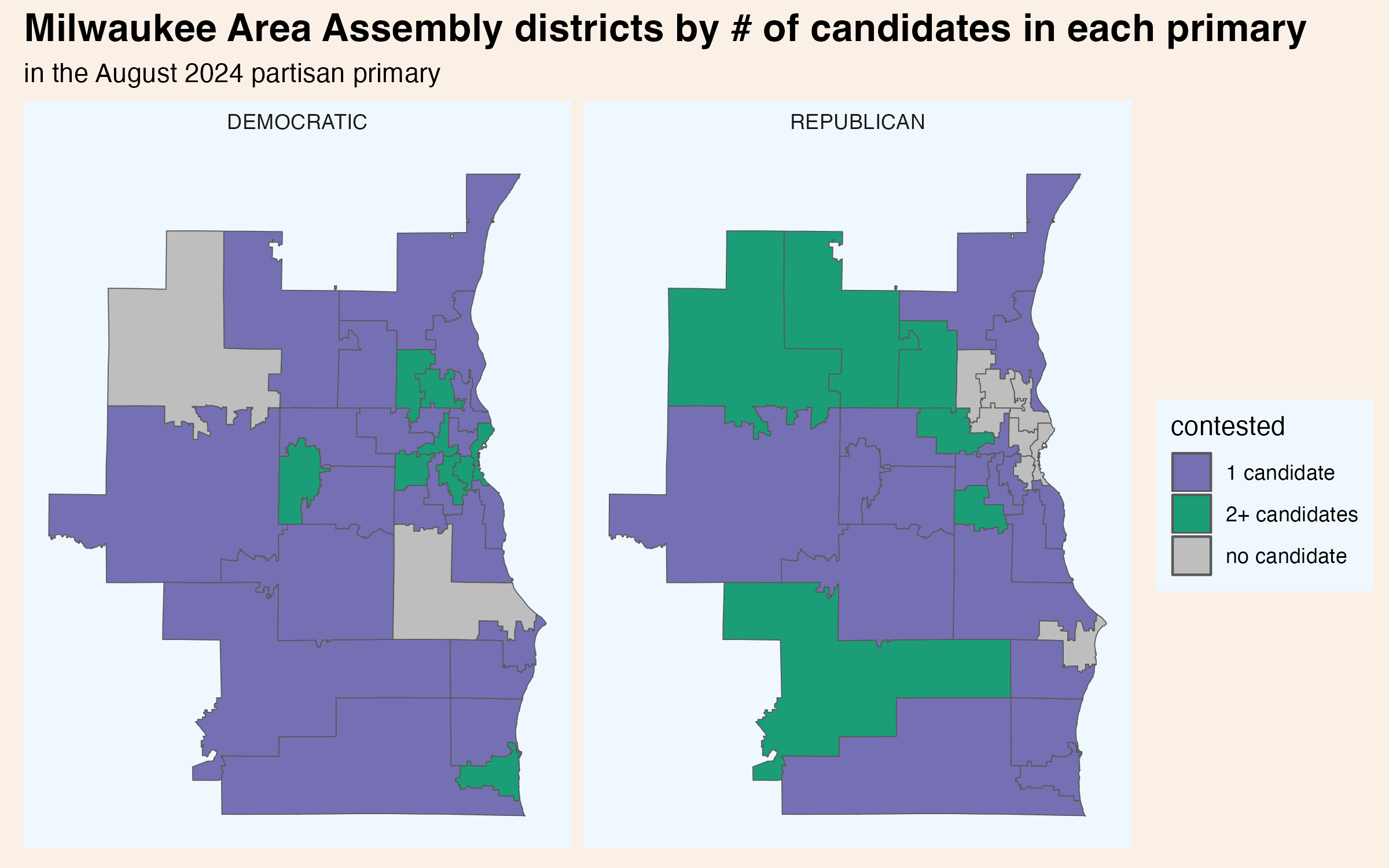
map showing contested primary status of MKE area assembly seats

Two of the most interesting Assembly primaries are occurring in the Milwaukee metro, scarcely 20 miles apart. Each features an incumbent legislator who sits to the ideological fringe of their party, and each has drawn a challenger supported by more mainstream members of their party.

The 24th Assembly district leans Republican by about 20 points. It covers parts of suburban Menomonee Falls and Germantown in southeastern Washington County. The current incumbent is Janel Brandtjen who has “drawn national attention as one of the Wisconsin Legislature’s most prominent purveyors of conspiracies about the 2020 election.” Current Republican State Senator Dan Knodl has chosen to run instead in the 24th Assembly district Republican primary. Brandtjen has been endorsed by Donald Trump himself, while Knodl has drawn support from Americans for Prosperity-Wisconsin.

The 19th district features a politician about as far removed from Janel Brandtjen as possible. Incumbent Ryan Clancy is a member of the Democratic Socialists of America and a cofounder of the state Assembly’s two-member socialist caucus. He is endorsed by many of the state’s leading progressive organizations and some left-leaning Democratic legislators. His primary challenger is Jarrod Anderson, a self-described “pragmatic progressive” with endorsements from numerous local Democratic politicians including the mayor, the county executive, the chair of the county board of supervisors, and the district’s previous incumbent.

Because both of these districts are strongly partisan—Republican in one case and Democratic in the other—contested primaries like these give voters a uniquely consequential choice between actual alternatives. For outside observers, they offer a unique opportunity to view the relative strength of the political coalitions which make up each party’s base.

Continue ReadingThe 2024 Wisconsin Assembly Races are the Most Contested in a Decade

Introducing the Lubar Center’s New Tool for Accessing Wisconsin Election Data

Past election results in Wisconsin aren’t always easy to find. Official, certified election results are spread across many different cumbersome Excel workbooks on multiple websites. And official statistics do not compile votes by municipalities.

To solve all of these problems, the Lubar Center has created a new online website, MULawPoll.org, which covers all presidential, gubernatorial, and congressional races from 2000 through 2022. It also includes state legislative races from 2010-2022. The website will be updated with 2024 results once they have been certified.

a screenshot of MuLawPoll.org

The website includes a chapter for every county, featuring demographic data and sortable/filterable tables allowing deeper exploration of voting trends. A user can quickly answer questions like “How did the village of Cedarburg vote in past presidential elections?” or “How many Dane County municipalities voted for Tommy Thompson in 2012?” We also provide a table of election results aggregated by every municipality in the state, where municipalities that straddle county lines (like Wisconsin Dells) are presented as a single unit.

Other chapters include a long term overview of partisan strength in Wisconsin, an essay by Craig Gilbert about Wisconsin’s uniquely competitive political environment, and a detailed look at Marquette Law Poll data pertaining to the 2024 election written by Charles Franklin.

The website’s election data have been compiled from official returns, collected either from the Wisconsin Election Commission or the Wisconsin Historical Society. The underlying data files, along with documentation and processing scripts are available here.

Please direct questions to John Johnson or Charles Franklin.

Continue ReadingIntroducing the Lubar Center’s New Tool for Accessing Wisconsin Election Data