
Facts and History — But No Predictions — as Program Sets the Political Scene

Set aside (for the moment) the poll numbers, the partisanship, and the passion and analyze the facts and data.

That was the goal of an “On the Issues with Mike Gousha” program on Thursday, June 14, at Marquette Law School that was a bit unusual. How so? The guests were Charles Franklin, director of the Marquette Law School Poll, and John Johnson, research fellow for the Law Schools Lubar Center for Public Policy Research and Civic Education, but, unlike the large majority of such sessions, particularly involving Franklin, they didn’t have any fresh poll results.

Instead, the goal, as Franklin put it, was to look at the lay of the political landscape, both in Wisconsin and beyond. Results from four special elections so far in 2018 for legislative seats in Wisconsin and from the statewide election of a Supreme Court justice offered the opening insights on current Wisconsin voting patterns. But the discussion expanded to encompass results from more than 300 elections nationwide since the 2016 presidential election and to look at history going back as far as the 1860s.

Franklin and Johnson showed the degree to which Democrats generally had gained ground since 2016 in election results in Wisconsin and nationwide. But Franklin looked at historical trends that show how the party of a sitting president usually loses ground in mid-term elections. What is shaping up for this fall’s elections may (or may not) be more in line with historical patterns than many people think.

One interesting insight: On average, Franklin said, the opposition party has gained 24 seats in the US House of Representatives in mid-term elections. And for the Democrats to gain control of the House this year, they need to gain 24 seats. That means it’s anyone’s guess which party will have the majority in the House after November. Or, as Franklin put it, “uncertainty is the order of the day.”

Franklin looked at the history of the impact on mid-term election of factors such as a president’s popularity, change in the national gross domestic product, unemployment rates, and the results of polling that asks people a generic question (with no candidate specified) about which party they hope will win the upcoming election. Based on history, some of those indicators suggest good prospects for Democrats – and some don’t.

The four special legislative elections in Wisconsin this year, as well as the Supreme Court election (assuming you assign partisan interpretation to it), each showed Republicans doing worse and Democrats doing better than they did in recent elections, Franklin and Johnson showed.

Some suggest that the low turnout in those races reduces the weight that should be put on such trends. Johnson analyzed results of special elections compared to general elections broadly and found that the differences in outcomes between the low turnout and high turnout elections were not as great as many people assumed.

But Franklin said a shift toward Democrats in the legislative elections in Wisconsin this fall wouldn’t necessarily mean changes in which party controls each legislative house in Madison. For example, few legislative elections in recent years have been settled by five percentage points or less, he said, so a five point shift toward Democrats might not change the winning party in many cases.

The first round of results for the Marquette Law School Poll since March is set to be released on Wednesday (June 20). It will include results for the Democratic primary for governor and the Republican primary for a US Senate seat. The pace of campaigning (and polling) will accelerate through the coming months.

But at this point, Franklin said, it was good to pause and look at the bigger and historical perspective.

“The main thing I want to leave you with is uncertainty (about what lies ahead), but I want you to appreciate why we are uncertain and how these different indicators are pushing in different directions,” Franklin said.

To view video of the one-hour conversation, click here. To get information on the poll release program at Eckstein Hall on June 20, click here.


Continue ReadingFacts and History — But No Predictions — as Program Sets the Political Scene

New Marquette Lawyer Celebrates Eckstein Hall and the Man Who Designed It

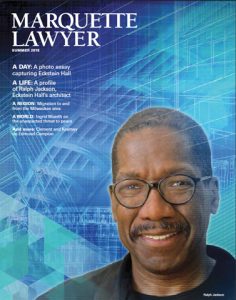
Image of Ralph Jackson on the Marquette Lawyer CoverHas it been 10 years already? Yes, the tenth anniversary is at hand for the groundbreaking for Eckstein Hall on May 22, 2008.

How have things worked out? Anyone who spends time—and especially anyone who spends a lot of time—in the home of Marquette Law School knows the answer: Very well.

The new issue of Marquette Lawyer magazine marks the anniversary of the start of building Eckstein Hall and celebrates the building’s success with two featured pieces, following an introduction by the dean including the famous photo of Tory Hill from the day of the groundbreaking.

One entry is a profile of Ralph Jackson, the Boston architect who was the lead figure in designing the building. Jackson, now retired, has a powerful personal story, rising from modest roots to national prominence as an architect. The story, “How Ralph Jackson Found His Voice,” may be read by clicking here.

The second feature is a photo essay on a day in the life of Eckstein Hall. The 22 pages of beautiful photos illustrate many of the facets of the identity of Marquette Law School as seen on one day, Nov. 14, 2017. The photo essay may be viewed by clicking here.

The new magazine includes other valuable reading, including:

“International Human Rights Law: An Unexpected Threat to Peace,” an edited text of the Boden Lecture delivered by Ingrid Wuerth, who holds the Helen Strong Curry Chair in International Law at Vanderbilt University. Read it by clicking here.

“Migration Challenges: Trends in People’s Movement to and from the Milwaukee Area and Wisconsin Illuminate Important Issues,” a piece in which John D. Johnson, research fellow with the Law School’s Lubar Center for Public Policy Research and Civic Education, and Charles Franklin, the Law School’s professor of law and public policy, analyze population trends. It may be read by clicking here.

“An Unveiling and a Blessing.” A portrait of St. Edmund Campion was unveiled at a ceremony on October 25, 2017, and now hangs in the Chapel of St. Edmund Campion in Eckstein Hall. An image of the portrait and the text of remarks at the ceremony—variously by the Hon. Paul D. Clement, Dean Joseph D. Kearney, Rev. Thomas S. Anderson, S.J., and the portrait’s artist, Henry Wingate—can be found by clicking here.

The “From the Podium” section includes texts of speeches at the Columbus Day Banquet of the Wisconsin Chapter of the Justinian Society of Lawyers on October 13, 2017, by the three honorees: State Public Defender Kelli S. Thompson, Dean Kearney, and Judge William Brash III. The section also includes “The Person on the Other Side of the Table,” the text of remarks from Michael J. Gonring, executive director of the Legal Aid Society of Milwaukee, upon receiving the Faithful Servant Award of the St. Thomas More Lawyers Society. Read the section by clicking here.

The Class Notes section, which may be read by clicking here, includes entries about Jessica Poliner, L’06, who coauthored a book with advice for improving gender equity in the workplace, and about Rachel Lindsay, L’11, who gained fame by appearing on the television programs The Bachelor and The Bachlorette, but who continues her work as a lawyer in Dallas.

To view the entire magazine, click here.

Continue ReadingNew Marquette Lawyer Celebrates Eckstein Hall and the Man Who Designed It

Prominent Sociologist Spotlights Community Organizations’ Role in Crime Reduction

America’s cities overall have experienced a remarkable decline in crime that began in the 1990s and that has brought improvements in civic life in some surprising ways.

But the strategies that played a significant part in reducing crime – including stop and frisk policing and mass incarceration – are fading, and different approaches are needed to sustain safety improvements.

And the strategies that should be pursued include building up the number and resources of community organizations that serve in many different ways to increase the quality of life in neighborhoods and doing as much as possible to encourage residents to take roles in helping that quality of life.

A leading figure in American thinking on how to improve the quality of life in urban areas presented that provocative perspective at a conference at Eckstein Hall on Wednesday. Patrick Sharkey, a professor of sociology at New York University, told an audience including leaders of many Milwaukee non-profit organizations that research and data back-up his assertion that such organizations are valuable. There is “really strong evidence” to show the value of community organizations, he said.

Continue ReadingProminent Sociologist Spotlights Community Organizations’ Role in Crime Reduction