Abele Offers Big Ideas in Law School Session — Like Making Milwaukee the State Capital

Chris Abele likes to think big. How big? Try this on:

“Move the capital.”

What? Move the state capital from Madison to Milwaukee? The idea was greeted with laughter when Abele, the Milwaukee County executive, floated it during an “On the Issues with Mike Gousha” program at Marquette Law School on Wednesday.

It’s hard to picture the odds of that coming to pass as anything other than flat zero. But Abele was serious – sort of. He knew it was not going to happen, but, he said, “you can’t talk me out of thinking about it.” There is “plenty of research” that shows the advantages in terms of economic impact and government efficiency of the state capital and the state’s largest population center being the same. Think of Boston, Denver, and Minnesota’s Twin Cities. 

Continue ReadingAbele Offers Big Ideas in Law School Session — Like Making Milwaukee the State Capital

Chicago, New York Heading in Opposite Directions on Crime; Where Does Milwaukee Stand?

To judge by some of the political rhetoric last fall, violent crime must be surging in our nation’s cities. Is that true? The answer may depend on which city you are talking about, and which neighborhood within that city.

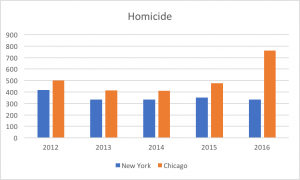
Consider the contrast between Chicago and New York. The Windy City had about 762 homicides in 2016, while the Big Apple had just 334. The difference is shocking, especially when you consider that New York has three times Chicago’s population.

To some extent, the contrasting figures from 2016 reflect longstanding trends. Although murders did spike in Chicago last year, New York has been doing better than Chicago on this score for a long time. The two cities had essentially identical per capita homicide rates in the late 1980s, but New York’s fell much faster and further than Chicago’s in the 1990s. New York has maintained a wide advantage ever since.

Still, the dramatic widening of that advantage in 2016 should be of great concern to Chicagoans. The chart below indicates the trends in recent years, based on FBI data. Note that the two cities moved in sync from 2013 through 2015: homicides down the first year, basically unchanged the next, and then up a little in 2015. However, in 2016, even as Chicago’s homicides shot up, New York’s dropped back down to where they had been in 2013 and 2014.

One should not get the sense, however, that one faces a dramatically elevated risk of violence throughout the Windy City.  

Continue ReadingChicago, New York Heading in Opposite Directions on Crime; Where Does Milwaukee Stand?

Media Should Inform the Public on Why, Not Just What, of Criminal Legalities

As we discussed potential procedures following the aftermath of acts causing tension between citizens of the Milwaukee area and police officers, a small group I was part of presented an interesting point. That point was that many times citizens are unaware of the on-goings of the criminal legal system. When situations arise in which officers or citizens are not found guilty subsequent to what seems to be a criminal act, onlookers are furious and the city burns—literally.

The media does little to help reduce the animosity, pointing fingers and creating distrust between residents and law enforcement by informing on the what, but failing to expand on the why. We as law school students are all legally educated, and most of us, at the least, have taken criminal law, even if we are not so knowledgeable as those who teach it. So, when an event takes place that seems unjust and nobody walks away in handcuffs, we understand why. The citizens of Milwaukee, however, don’t have that same knowledge and are understandably outraged.

Continue ReadingMedia Should Inform the Public on Why, Not Just What, of Criminal Legalities