
Author Describes Amazon’s Boom – and the Downsides of What It Does to Communities

Enormous selection, good prices, quick delivery, the safety and comfort of shopping from home – what’s not to like about Amazon?

Mike Gousha put that question to Alec MacGillis, in an “On the Issues with Mike Gousha” program posted on the Marquette Law School’s web site on April 21, 2021.

“There’s a lot not to like,” MacGillis answered. He spells out what he means – as well as the reasons so many people love Amazon – in a broad and deep look at the company and its impact in his new book, “Fulfillment: Winning and Losing in One-Click America.” And he described much of what he found in researching the book in his conversation with Gousha, Marquette Law School’s distinguished fellow in law and public policy.
Continue ReadingAuthor Describes Amazon’s Boom – and the Downsides of What It Does to Communities

Want Politicians to Prioritize the Greater Good over Partisanship? Change Election Rules, Speakers Say

You want to do something about the partisan polarization that puts the United States Congress into frequent gridlock? Katherine Gehl and Austin Ramirez say there is a solution that has nothing to do with any specific policy or how people define themselves when it comes to partisanship: Change the way Congress members are elected.

“It turns out what really matters is the system, the rules of the game,” Gehl said during an “On the Issues with Mike Gousha” program posted on the Marquette Law School web site on April 8, 2021. The game she referred to is the way politicians get re-elected. Single-party primary elections motivate them to take highly partisan positions that play to small, but decisive blocks of voters within their party.

“Currently the system pushes – forces — the sides apart,” Gehl said. What’s best in the big picture doesn’t count the way that it counts to do what’s best for winning a party primary or keeping others from launching primary challenges.

“Our task is to make keeping the job the same as getting results for the country,” she told Gousha, Marquette Law School’s distinguished fellow in law and public policy.

Continue ReadingWant Politicians to Prioritize the Greater Good over Partisanship? Change Election Rules, Speakers Say

Congratulations to the 2021 Jenkins Honors Moot Court Competition Finalists

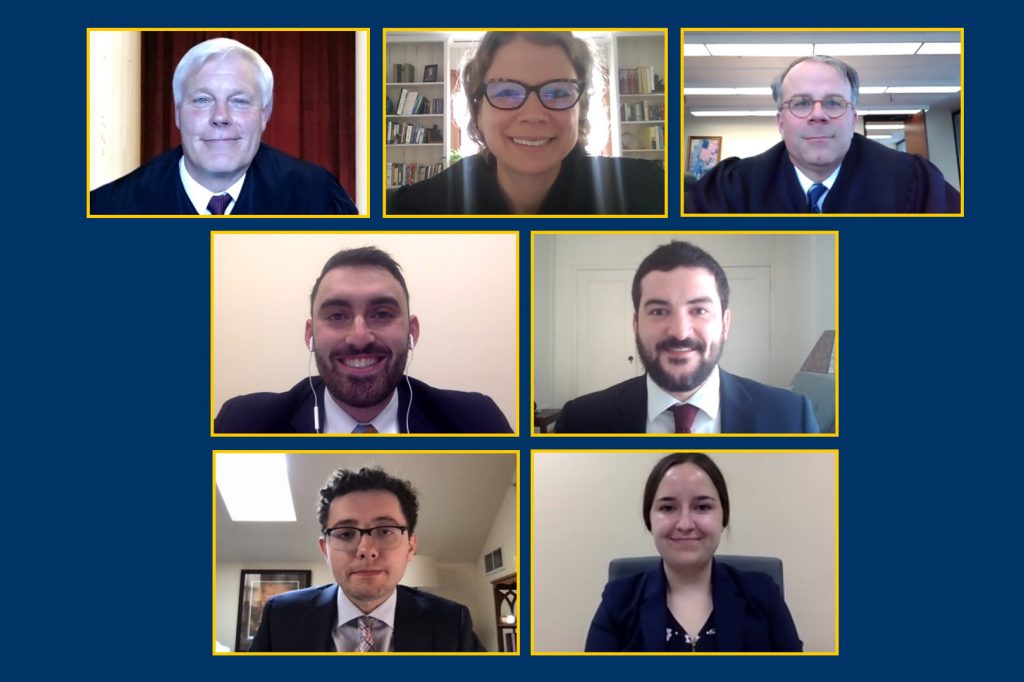
screenshot of zoom moot court competition, with head shots of three judges and four competitorsCongratulations to the winners of the 2021 Jenkins Honors Moot Court Competition, Ben Edelstein and Kyle Frank. Congratulations also go to finalists Alexander Lux and Natalie Mulvey. Frank won the Ramon A. Klitzke Prize for Best Oralist. Ashleigh Dickey and Matt Rademacher won the Franz C. Eschweiler Prize for Best Brief.


Presiding over the final round were Hon. Paul Thissen (Minnesota Supreme Court), Hon. Michael Y. Scudder (United States Court of Appeals for the Seventh Circuit), and Hon. Cynthia M. Davis (L’06) (Milwaukee County Circuit Court). This year’s final round was held virtually on Zoom but livestreamed over YouTube. More than 70 people watched the final round on YouTube.


Many thanks to the law school’s media and tech team for making all the tech magic happen. Thank you, too, to the law school administrators and staff who helped coordinate the event and to Dean Kearney for his support of the competition and his front-line presence as host. And special thanks to 3L Kelsey Pelegrin, who handled the details of the competition.


Students are selected to participate in the competition based on their success in the fall Appellate Writing and Advocacy class at the Law School.


Here is a link to a recording of the final round.

Continue ReadingCongratulations to the 2021 Jenkins Honors Moot Court Competition Finalists