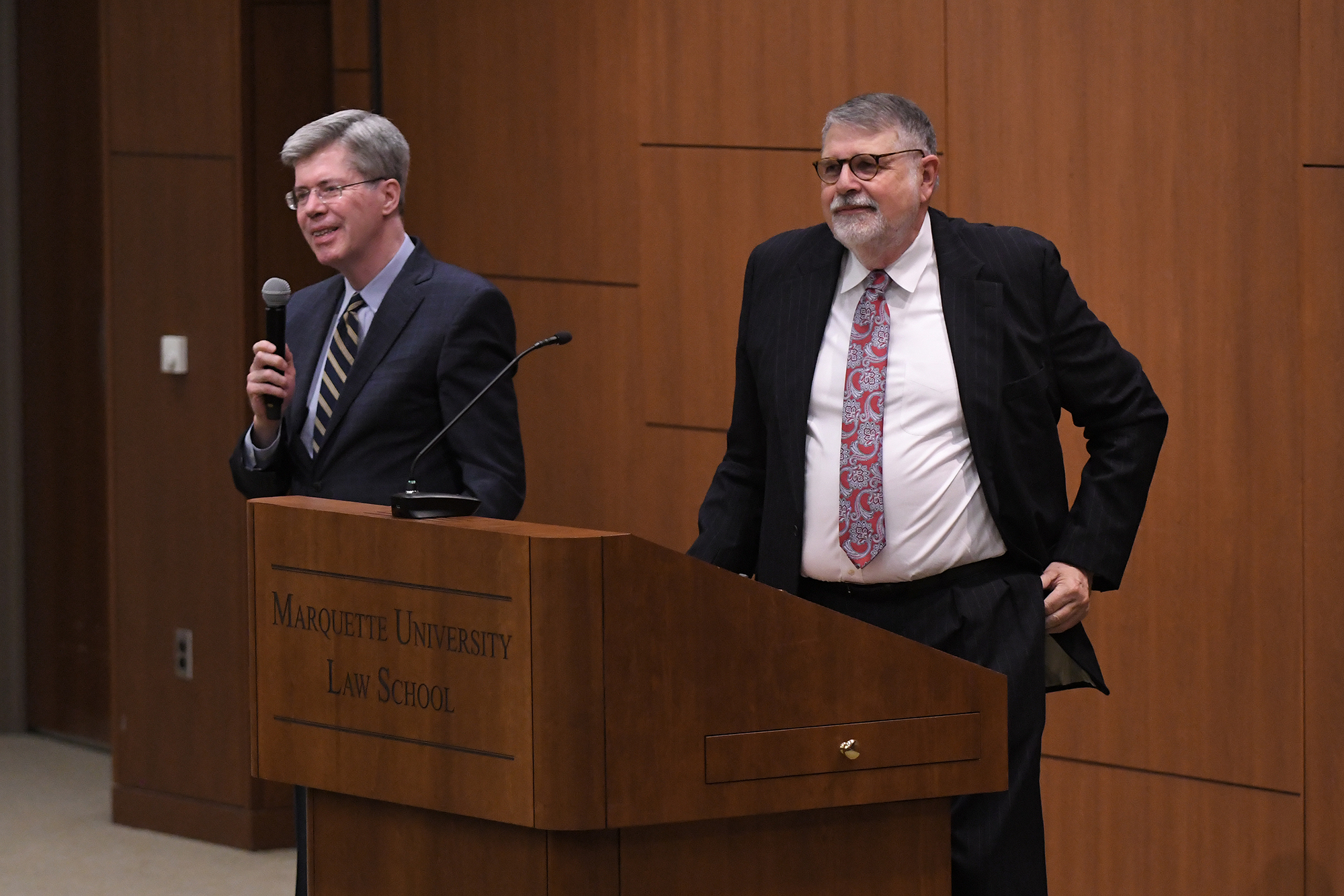
Sometimes, the personal stories of public officials can be self-serving and just plain not interesting. But sometimes they can be insightful and compelling, saying important things about the individuals, the work they do, and life more broadly.
Two recent “Get to Know” programs at Marquette Law School, hosted by Derek Mosley, director of the Lubar Center for Public Policy Research and Civic Education, were definitely in the latter category. Each spotlighted a person who holds an important job. But the biography of each – and their life stories are very different — says a lot about the character of Milwaukee and the challenges the city faces.
Aaron Lipski, chief of the Milwaukee Fire Department, spoke with Mosley on Oct. 9, 2025. He has been in the news often in recent times, including for his strong advocacy of putting sprinklers in older apartment buildings in the light of fatal fires and for his call for the Milwaukee city budget to sharply increase spending on new trucks and equipment for the fire department.
The Hon. Michael Y. Scudder, judge of the U.S. Court of Appeals for the Seventh Circuit, delivered this year’s Hallows Lecture, yesterday evening, to more than 200 individuals in Eckstein Hall’s Lubar Center. The lecture was exemplary.
The E. Harold Hallows Lecture is an annual highlight at Marquette University Law School. Most often delivered by a judge, the lecture is an opportunity to welcome into our community an accomplished individual from whom all of us interested in the law—students, faculty, other judges, lawyers, and all manner of interested individuals—might learn.
This was not Judge Scudder’s first trip to Marquette Law School, as he presided at the Jenkins Honors Moot Court Finals in 2023 (his similar service in 2021, during the COVID era, having been undertaken remotely by Teams). The judge keeps close to law schools, it would seem—for example, teaching national security law at the University of Chicago Law School and advanced federal jurisdiction at the Northwestern University Pritzker School of Law. Judge Scudder’s interest in legal education, especially in the Seventh Circuit’s region of Wisconsin, Illinois, and Indiana, is impressive and inspiring more generally.
Judge Scudder’s Hallows Lecture was titled “Resorting to Courts: Article III Standing as the Guardian of Free Speech & Democratic Self-Governance.” It proceeds in two main parts.
The first half explains and defends the standing requirement in federal courts. The judge describes the precept’s basis in the “Cases” or “Controversies” requirement of Article III of the Constitution, defends it as a structural limitation on the exercise of judicial power, yet acknowledges the ideological lens through which many individuals seem to view standing issues. The lecture offers a defense of the cases and a strong, institutions-based justification of the concept.
The lecture’s second half explores the relationship between the Case or Controversy requirement and free speech. It emphasizes that the standing requirement—particularly by disfavoring pre-enforcement facial challenges to government policies on very broad grounds—appropriately encourages people to hash out their differences in forums envisioned and intended as policy-setting. This half laments the echo chambers into which many individuals have placed themselves in our society and hopes that more open, respectful, and constructive dialogue, outside of courts, can occur to sort out the “cultural” issues and policies needing resolution at all levels of government.
Here’s a flavor:
. . . . This is how Article III’s limitation on the exercise of judicial power leaves policymaking, and the difficult line drawing it often entails, to the exercise of free speech. Speaking up, objecting, and sharing perspectives with those who differ from us is how we understand, persuade, and, often, find common ground where agreement seems beyond reach.
If that framing is too idealistic in today’s times, I would hope skeptics would at least recognize that the alternative—permitting very difficult legal questions to come to federal court based only on a showing of a genuine worry—casts a vote of little confidence in the role speech can play in finding solutions, or perhaps tolerable compromises, to some of the most divisive questions of our day. And even if these culture war lawsuits should not be viewed as a vote of confidence in federal courts as the ultimate decision makers, they put great pressure on principles of restraint designed to allow democratic processes—whether at the national or local level—to offer answers and outlets for persuasion and compromise in the first instance.
Our constitutional design envisions constitutional answers coming in slower-paced increments than contemplated by pre-enforcement facial challenges like the one Parents Protecting Our Children lodged against the Eau Claire policy. It is not happenstance that the architect who designed the Supreme Court, Cass Gilbert, thought the tortoise an appropriate decorative and symbolic feature for the building’s design. In the same way tortoises move slowly, sometimes the law develops best when principles, doctrines, and answers come with time and, I might add, with more speech and dialogue helping to bridge social divides. Pre-enforcement facial challenges, however, often result in expansive injunctions that apply in one fell swoop—the sort of forward-looking policymaking that is best left to the more democratic branches.
Judge Scudder’s lecture was outstanding, even beyond its timeliness. While versions of it will appear in the fall Marquette Law Review and Marquette Lawyer, one can watch the lecture here or read a working copy of it here.
James Obergefell grew up in a blue collar, Catholic family in Sandusky, Ohio, got an undergraduate degree from the University of Cincinnati, and became a high school teacher.
“I was deep in the closet,” he said as he told his story during a program Wednesday, Sept. 18, 2024, in the Lubar Center at Marquette Law School. He came out in the early 1990s while he was in graduate school and met John Arthur. Within a short time, they considered themselves married. Legally, they were not – at the time, same sex marriage was not legal anywhere in the United States. But beginning in the mid -990s, they decided they wanted “marriage and everything that came with it,” as Obergefell put it.
Obergefell told Derek Mosley. executive director of the Law School’s Lubar Center for Public Policy Research and Civic Education, who moderated the conversation before a capacity audience of more than 200. how the legal landscape began to change, including a US Supreme Court decision in 2013 that struck down a federal law known as the Defense of Marriage Act. During the same period, Arthur’s health declined sharply after being he was diagnosed with ALS in 2012.
After the Supreme Court decision, Obergefell and Arthur decided to get married. Because Arthur’s health was so precarious, they needed to act quickly. And because legalities involving marriage varied across the country, they ended up taking a medical ambulance flight to the Baltimore/Washington airport in Maryland, where they could have a ceremony without ever getting off the airplane. Three months later, Arthur died.
What emerged from their marriage was a court case focused on whether Obergefell was the surviving spouse legally. And that case was joined with similar cases that ended up before the US Supreme Court, resulting in the landmark decision of Obergefell v. Hodges in 2015 which made same sex marriage legal throughout the United States. Obergefell recounted the events of the day the Supreme Court decision was issued. “I burst into tears” in the courtroom, he said. “For the first time in my life as an out gay man, I felt like an equal American,” he said. The audience applauded when he said that.
Obergefell’s name became a big part of American legal history. And Obergefell himself moved from being a person of no prominence and no notable involvement as an activist into a continuing spotlight. It made him, as Mosley put it at the Law School program, “the face of the case,” someone who continues to be an advocate for rights of many kinds and someone who tells his personal story openly and with impact. Obergefell said he has realized how “stories matter — stories can change hearts and minds.”
“Going through something like this has a profound impact,” Obergefell told the audience. “It changes you.”
Obergefell said he is still motivated by anger over things he sees as wrong and the need to advocate for the rights of people facing many different situations. He also has less intense involvements, such as co-owning a wine label that has raised more than $250,000 for causes supported by him and the co-owner.
“Nothing makes me happier than to know that young people today are growing up in a world where the question of their right, their ability, to get married and have that relationship recognized is there.” Obergefell said. “I had the absolute honor and privilege of being part of making things better for people younger than I am.”
Video of the one-hour program may be viewed by clicking below.