
George Orwell on Writing Well

George Orwell’s Nineteen Eighty-Four and Animal Farm are familiar reading for many of us. A few years ago a student suggested I also read his essays, and in particular, “Politics and the English Language.” George Orwell, A Collection of Essays 156-71 (10th ed. 1981).

In this essay, Orwell claims that the English language is in decline, and that the decline has “political and economic causes.” (156) Orwell asserts, however, that the “bad habits” in written English can be avoided. (157) He reasons that in getting rid of these habits, “one can think more clearly, and to think clearly is a necessary first step toward political regeneration: so that the fight against bad English is not frivolous and is not the exclusive concern of professional writers.” (157)

Continue ReadingGeorge Orwell on Writing Well

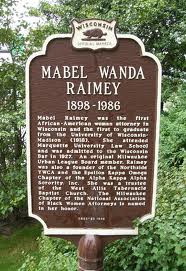
Mabel Watson Raimey

Recently a friend lent me a wonderful book, More than Petticoats: Remarkable Wisconsin Women, by Greta Anderson.* The book biographies a number of notable Wisconsin women, but the biography that stood out the most to me was of Mabel Watson Raimey.

Mabel Watson Raimey was the first African-American woman to attend Marquette University Law School. (117) She worked during the day and went to law school at night. (117) She was the first African American female lawyer in Wisconsin, entering the profession in 1927. (118)

Ms. Raimey went to law school a few years after she was fired from her job teaching elementary school in Milwaukee: she was let go on the third day of school after school officials learned of her race. (114-15) Ms. Raimey had been a distinguished student before entering the teaching profession. (116) She graduated from West Division High School at fourteen and obtained an English degree at the University of Wisconsin. (116-17)

Continue ReadingMabel Watson Raimey

The Law in Shakespeare’s Works

Last Friday I had the pleasure of listening to an interview on WPR with Stephen Marche, author of the book, How Shakespeare Changed Everything.*

During the interview, Mr. Marche talked about how many English words were first used by Shakespeare.  Lawyers can thank Shakespeare for words like “negotiate”, “compromise”, and “circumstantial”.** The conventional wisdom is that Shakespeare invented those words, although Mr. Marche acknowledged that Shakespeare may really have been the first person to write down words that were already in use at the time.  (I think the latter may be more likely, although I do not claim to be an expert on this matter.)

The interview got me thinking about references to the law in Shakespeare.  A quick search online referred me to a 2009 conference at the University of Chicago Law School on “Shakespeare and the Law.”  Another quick journal and law review search on Westlaw showed a number of references to Shakespeare.

Do any of our readers have a favorite Shakespeare passage or play?  What are your thoughts on Shakespeare and the law?  What influence, if any, has Shakespeare had on the public’s view of the law and lawyers?  Did Shakespeare use legal concepts correctly in his plays?  Do you think that Shakespeare really coined all the words for which he is credited?  Is there anything that lawyers can learn from reading Shakespeare?

I very much look forward to reading Mr. Marche’s book.

Continue ReadingThe Law in Shakespeare’s Works