
President for a Day
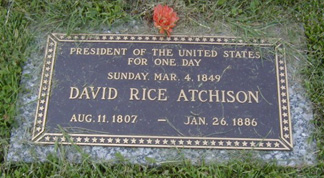 Today marks the 161st anniversary of the one-day Presidency of the United States of David Rice Atchison. Atchison’s story, once well-known, has been reduced to an item of trivia for American history buffs.
By common agreement, the Presidential term of James Knox Polk ended at noon on March 4, 1849. March 4 was a Sunday that year, and the decision was made to delay the inauguration of Zachary Taylor, the hero of the recently concluded Mexican-American War and the newly elected President, until Monday, March 5. Polk completed his final presidential duties on Sunday morning and then departed from Washington that afternoon.
Who then was President between noon on March 4, when Polk departed, and noon of March 5 when Taylor finally took the oath of office?
Under the presidential succession statute in effect in 1849, the President Pro Tempore of the Senate was to assume the office of President of the United States if neither the President nor the Vice-President were able to do so. During the 30th Congress, David Rice Atchison, a senator from Missouri, had been the President Pro Tem of the Senate, and on the morning of March 5, 1849, he was reelected to the same post for the 31st Congress. Legend has it that Atchison spent the day of March 4 in bed, recovering from his participation in several parties held on the evening of March 3.
At the time, no one seemed to have noticed that the office of President had fallen vacant, and there is no contemporary evidence that Atchison himself suggested to anyone that he was the President. However, later in life — Atchison was only 32 on March 4, 1849, and he lived until 1886 — he frequently claimed that he had been President of the United States for one day.
The question of whether or not Atchison had actually been President was raised by a handful of commentators in January 2009, when Chief Justice Roberts botched the oath of office taken by President Obama. Obama retook the oath, correctly, the following day, but if a proper recitation of the oath is a prerequisite to becoming President of the United States, then who was President on January 20, and who was president on January 21? (Since Vice-President Biden had been sworn in at that point he presumably would have been next in line.)
There are, however, a number of problems with the claim that Atchison was President of the United States on March 4, 1849. First of all, he failed to take the oath of office, and the Constitution specifically states that the President must either swear or affirm the prescribed oath.
Even more problematic is the fact that Atchison was technically not the President Pro Tempore of the Senate on March 4, 1849. Under the practices of the day, the office of President Pro Tempore of the Senate was understood to expire when the current Congress recessed for the final time. The first order of business for the new Congress was to elect a new President Pro Tem, although it was not unusual for the Senate to reelect the previous holder of the position.
The Thirtieth Congress recessed on March 3, 1849, so Atchison’s term ended the day before Polk’s presidential term expired at noon. Moreover, his new term as President Pro Tem of the Senate during the 31st Congress did not begin until the morning of March 5. Consequently, if Atchison was eligible to serve as President, it was only during the time between his swearing in on the morning of March 5, and Taylor’s taking the oath of office at noon.
Actually, by this logic, Atchison’s already truncated presidency would have ended with the swearing in of Vice-President Millard Fillmore shortly before noon, and Fillmore’s presidency would have ended a few minutes later when Supreme Court Chief Justice Roger Taney swore in President Taylor. Ironically, Atchison terminated his own presidency (under this theory) when he, as the newly elected President Pro Tem of the Senate, swore in Vice-President Fillmore. (Fillmore, of course, became President “again” in July 1850, when Taylor died in office.)
As it turns out, the Sunday presidential inauguration problem has occurred a number of times in American history. Logically, it should occur once every 28 years or so, since there are seven days to the week and inaugurations occur every four years.
The problem first occurred on March 4, 1821, when James Monroe was President. His inauguration for his second term was delayed for one day, and no one at the time appears to have noted any gap in the presidency. John Gaillard of South Carolina, who served as President Pro Tem continuously from January 25, 1820, to December 2, 1821, never claimed to have been President on March 4, 1821.
The second incident was the one involving Taylor and Atchison. The third came in 1877, following the Hayes-Tilden race, the most contested presidential election in American history. Although the results of the election were not finally determined until Friday, March 2, Hayes, for religious reasons, refused to be sworn in on Sunday, March 4. Several Republicans, including outgoing President Ulysses S. Grant, feared that disgruntled Democrats might attempt to disrupt the inauguration ceremonies, so they encouraged Hayes to take the oath of office as soon as possible. Consequently, Hayes took the oath of office on Saturday, March 3, the day before the end of Grant’s term. He also took the oath a second time (without incident) at a public ceremony on Monday, March 5.
In 1917, Woodrow Wilson delayed his second inauguration until March 5, but as had been the case with Monroe a century earlier, there was no evidence of contemporary claims that the presidency had fallen vacant.
In 1933, the 20th Amendment to the Constitution moved the presidential inauguration date to January 20. The first conflict with the new date came on Sunday, January 20, 1957. President Eisenhower, who had been reelected the previous November, took the oath of office privately on Sunday, and then was publicly inaugurated the following day. Ronald Reagan took the same approach when the date of his second inaugural fell on Sunday, January 20, 1985. Either President Obama or his replacement will have to deal with this issue in three years, as January 20, 2013, will fall on a Sunday.
The logical answer here is that the newly elected President becomes President on the appointed day, whether or not he (or she) has an inaugural ceremony or takes the required oath. The supposed problem of a gap in the presidency in 1849 should remind us that for all of their wisdom, the Founding Fathers did not think of everything, and there are times when the Constitution requires us to use common sense to implement its central provisions.
A picture of the Plattsburg, Missouri tombstone of David Rice Atchison—which proclaims him “President of the United States for One Day”—can be found here.
I am indebted to Sean Samis for calling this anniversary to my attention earlier today.
 The Supreme Court decision in