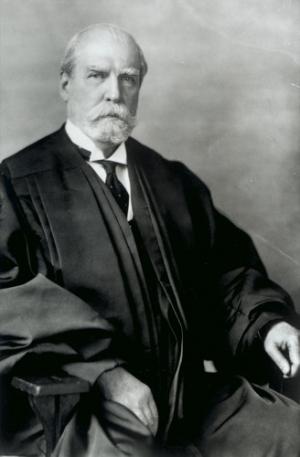
 This year’s Boden Lecturer, Prof. Thomas Merrill, is the Charles Evans Hughes Professor of Law at the Columbia University Law School. In addition to providing insight in the fascinating Wisconsin case of Melms v. Pabst, his presence also reminds us of an important connection between the Marquette Law Review and Charles Evans Hughes.
Charles Evans Hughes (1862-1948) was one of the great luminaries of American Law. He is the only individual to have served two separate stints on the Supreme Court (1911-1916 and 1930-1941, the latter as Chief Justice). He also served as Secretary of State in the Harding and Coolidge administrations, and he and William Howard Taft are the only two men in American history to have both served on the Supreme Court and have been a major party nominee for president of the United States. However, unlike Taft, who was elected president in 1908, Hughes lost the presidential election of 1916 to incumbent Woodrow Wilson, although in terms of electoral votes, it was one of the closest elections in American History. (Wilson won by an electoral vote margin of 277-254. Had less than 2,000 Californians switched their votes from Wilson to Hughes, Hughes would have become the 29th president of the United States.)
Hughes’ connection to Marquette came shortly after the 1916 election. Although Woodrow Wilson ran for re-election with the slogan “He kept us out of war”[World War I], barely a month after the beginning of his second term, the U.S. declared war against Germany and the other Axis powers. The declaration of war led to a mobilization of the American economy under the direction of the national government that was without precedent in American history, and at least some observers questioned the constitutionality of the actions of the Wilson Administration and Congress.
By the summer of 1917, Hughes had returned to the private practice of law in New York City, but he quickly came to the defense of the policies of his former rival. In an address entitled “War Powers under the Constitution,” delivered to the American Bar Association at its annual meeting on September 5, 1917, Hughes endorsed the broad interpretation of presidential power embraced by President Wilson. The address was widely hailed by those who supported the American war effort and thousands of copies of the address were distributed to newspapers and other groups by the ABA.
The address was also published as the lead article in Volume 2, Issue 1 of the Marquette Law Review, which appeared only a few months after the address was first delivered. The law review had been founded only the year before, and the journal received a major boost in credibility and visibility with the presence of Hughes already famous address in what was only its third issue.
As the Law Review itself noted at the opening of the issue, “The Marquette Law Review starts its second year as a legal publication with a great deal more confidence than it did the previous year.” Being able to attract contributors of the stature of Charles Evans Hughes was indeed a reason to feel confident.
How it was that the Marquette Law Review acquired the rights to be the only law review to publish Hughes’ address is not clear. The Review itself revealed no such information, although in an editorial it did thank Hughes for granting it permission to publish the address. None of Hughes’ biographers make any reference to a Marquette connection; however, one is tempted to speculate that the connection came through faculty member Carl Rix, who was the law review’s faculty adviser in 1917, and who was an active member (and a future president) of the American Bar Association.
While Rix may be the connection, he did not attend the 1917 ABA meeting which was held in Saratoga Springs, New York. In fact, that year only two lawyers from Milwaukee, Edward Fairchild and W. A. Hayes, attended the annual meeting , and neither had any connection to the Marquette Law School.
It may simply have been that some enterprising member of the law review staff came up with the idea of contacting Hughes and offering to publish his address.
In any event, its publication brought the law review a great deal of attention, and forever established a linkage between Marquette and Charles Evans Hughes.

 In a 1986 law that must surely rate as one of Congress’s most ill-informed overreactions to a high-profile tragedy– the cocaine-related death of college basketball star Len Bias — a new mandatory minimum ten-year sentence was created for drug offenders involved in dealing 50 or more grams of “cocaine base.” Never mind that Bias used the powder form of cocaine. Never mind that crack — the form of cocaine that everyone was most concerned about at the time — is only one type of cocaine base. Congress instead chose to direct the harsh new penalties at cocaine base, a category that is narrower than all cocaine, but broader than just crack (at least if the term ”cocaine base” is understood literally). As is now well known, the result of this unfortunate law has been to create massive racial disparities in federal drug sentencing between white defendants (who are typically involved with powder) and black defendants (who are more typically involved with crack).