Richard Florida Calls for Spreading the Success of “Urban Revival”

Richard Florida describes himself as a thinker. “I sit in a little room with a computer and think thoughts and write them down,” he told a capacity audience or more than 200 in the Lubar Center of Marquette Law School during an “On the Issues with Mike Gousha” program on Thursday.

But his thoughts have made him an influential and widely-followed analyst of the trends shaping urban life in North America. His 2002 book, The Rise of the Creative Class, predicted that there would be a surge of vitality in cities where creative people – tech innovators, artists, entrepreneurs, and so on  – clustered.

“I really under-predicted,” Florida told Gousha. In following years there was “an urban revival on steroids.”

The trends he foresaw have shown up in Milwaukee. “It’s amazing what’s happened here,” Florida said, mentioning some of the things he had done and seen since arriving the previous day. “Milwaukee has done a fabulous job of reinventing itself.”

But the boom in urban living and economic vitality has brought with it downsides, Florida said. All you need to know is the title to his new book to catch his concerns: The New Urban Crisis: How Our Cities Are Increasing Inequality, Deepening Segregation, and Failing the Middle Class – and What We Can Do About It.

Continue ReadingRichard Florida Calls for Spreading the Success of “Urban Revival”

Wisconsin Grows, but Most Municipalities Shrink

On May 25, 2017, the Census Bureau released its 2016 annual population estimates for subcounty geographic units.[1] This granular level of detail allows us to look more closely at where population change has occurred across the state.

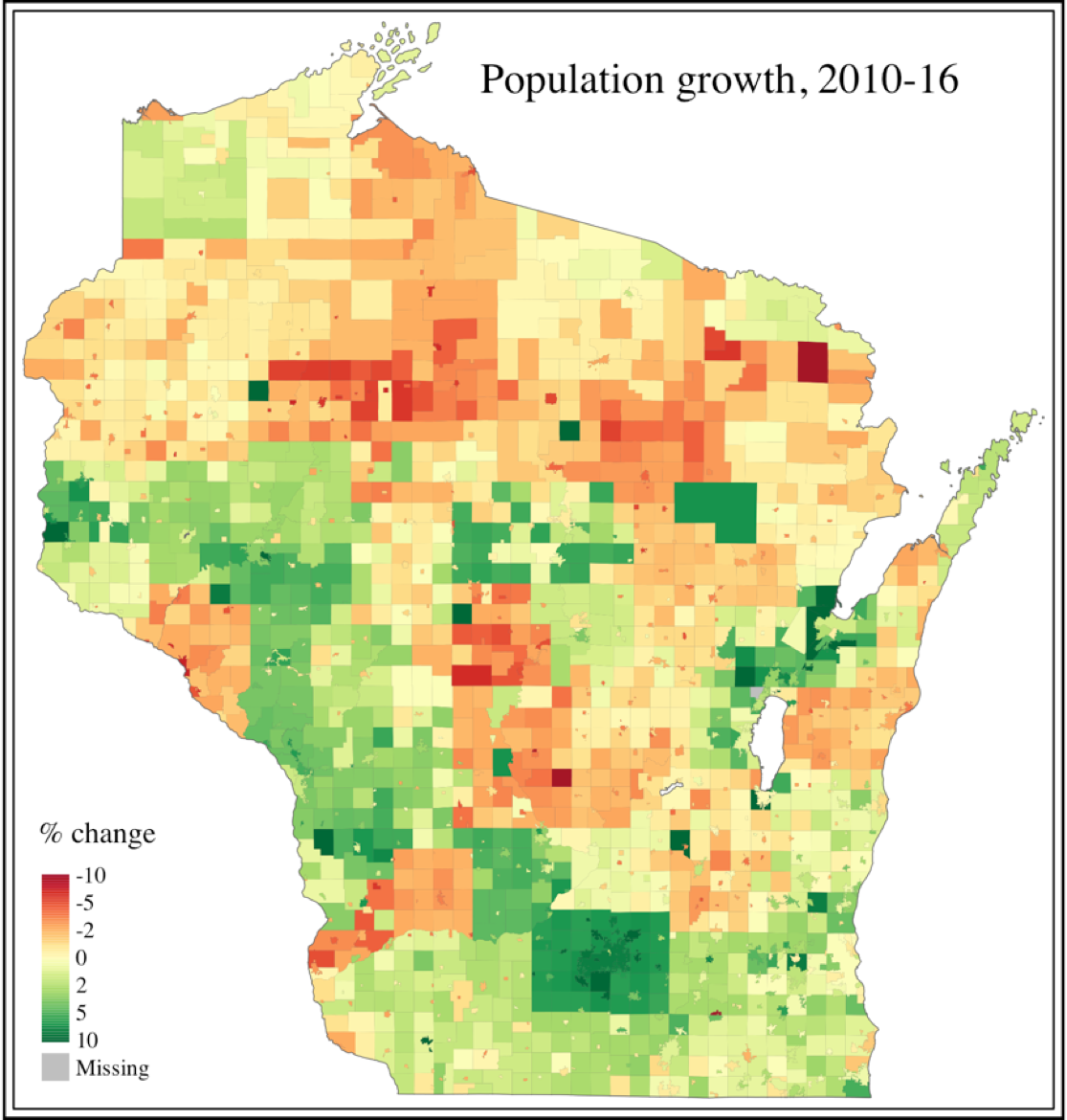
As a whole, Wisconsin gained an estimated 91,419 people between July 2010 and July 2016—including 10,817 in the year ending July 2016. But these headline numbers obscure major variation across the state. Of the more than 1,850 cities, towns, and villages making up Wisconsin, 833 grew since 2010 and 986 of them shrank. Smaller places tended to get smaller, while bigger places got bigger. In 2010, 70 percent of the state lived in municipalities which would grow in the next six years, compared to just 30 percent in municipalities that would shrink. Much of this loss was concentrated in the northern region of the state, with the notable exception of several communities in Douglas County near Duluth, MN.
The map above shows the percent change in population for each Wisconsin municipality from 2010 to 2016.[2] The Green Bay/Appleton and greater Madison regions saw some of the highest growth, with additional sustained growth occurring in the Western part of the state including La Crosse, Eau Claire, and the Minneapolis/St. Paul suburbs. Nearly all portions of Marathon County surrounding Wausau have also experienced growth since 2010, although the City of Wausau itself declined marginally. This stands in stark contrast to nearby Rusk County, which lost 4 percent of its total population over the same time period. The only county to fare worse was neighboring Price County where the population declined by 4.5 percent. Dane County fared best with 9 percent growth, followed by tiny Menomonee (7 percent) and Green Bay area Brown County (5 percent).
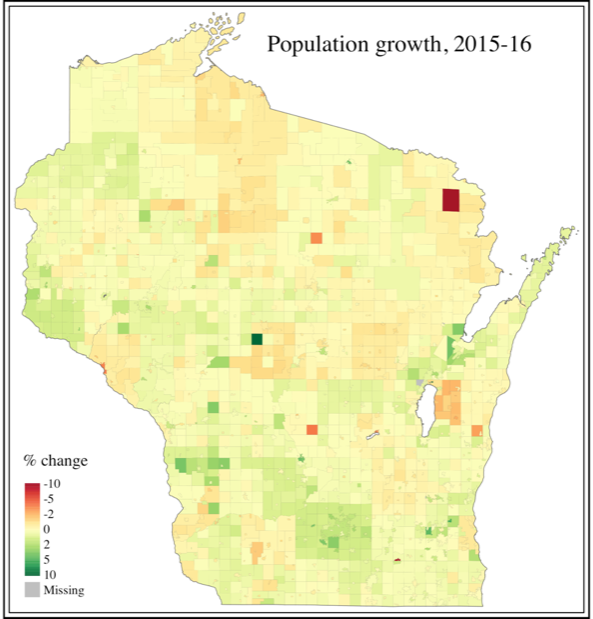
Applying the same scale to just the past year’s change reveals similar, though necessarily less severe, trends. From 2015 to 2016 the City of Milwaukee lost an estimated 4,300 people, or about 0.7 percent of its population. Combined with a minor decline the year before, this essentially wiped out the city’s slight growth from 2010 to 2014.

Despite stagnant population size in places like Milwaukee and Wausau, Wisconsin’s growth is driven by its most populous communities. Municipalities with populations of at least 10,000 grew an average of 1.5 percent from 2010 to 2016. Municipalities with less than 1,000 residents shrank an average of 0.5 percent.


[1] Estimates are for July 1 of each year.

[2] I use the Census Bureau’s July population estimate base for 2010, not the decennial census. The technical unit of measurement in the map is Minor Civil Division (MCD), which corresponds with Wisconsin’s municipalities except in situations where municipalities cross county lines. In those rare cases, each county’s portion of the municipality is measured and mapped uniquely. Statistics in the report, however, reflect the total figures for each municipality.

 

Continue ReadingWisconsin Grows, but Most Municipalities Shrink

Panelists Say New Assessment Tool Makes Pre-Trial Release Decisions “Smarter”

One of the most important decisions a judge or court commissioner makes in handling criminal cases is whether the defendant should be kept in jail or released while awaiting an outcome. A person’s constitutional rights and the community’s need for safety need to be weighed.

At an “On the Issues with Mike Gousha” program at Marquette Law School on Wednesday, Maxine White, chief judge of the Milwaukee County Circuit Court, summarized the obligation of judges and commissioners when making those decisions: “To do everything possible to get it right.”

“When I started as a judge 25 years ago, the ‘getting it right’ was all in Maxine’s head and Maxine’s gut,” White said. “Since that time, we’ve gotten smarter.”

The tool that is being used now as a key to getting smarter was the focus of the program in the newly-named Lubar Center (previously the Appellate Courtroom) at Eckstein Hall as White, L’85, along with Milwaukee County District Attorney John Chisholm and Wisconsin First Assistant State Defender Tom Reed, described a scoring system that is being used in Milwaukee County and almost 30 other jurisdictions around the United States to better inform decisions on releasing or incarcerating those awaiting outcomes of criminal complaints.  

Continue ReadingPanelists Say New Assessment Tool Makes Pre-Trial Release Decisions “Smarter”