Completing the Revolution

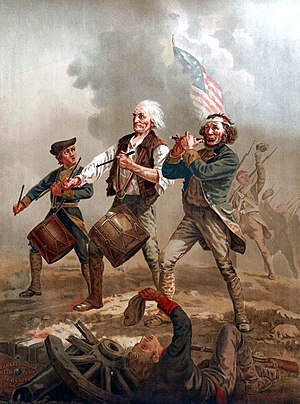
Painting depicting a Revolutionary War scene of a young drummer boy, an older man, and another soldier playing the fife as all three march across a battle fleld. Prof. David Strifling rightly draws our attention to what he terms “the quiet revolution” taking place in Wisconsin administrative law.  As deputy legal counsel for the governor several years ago, I was privileged to be a foot soldier in that revolution, which sought to reinvigorate core constitutional principles around the separation of powers, government transparency, and executive responsibility.  Thus far, the revolution has primarily been fought in the legislature (primarily through 2011 Act 21 and 2017 Act 57) and the executive branch (especially the Governor’s Executive Order 50 and the Attorney General’s opinion 01-16).

The Wisconsin Supreme Court will soon have its opportunity to join and accelerate the revolution when it hears and decides Tetra Tech v. DOR (Court of Appeals decision) and LIRC v. DWD (Court of Appeals decision) (scheduled for argument Friday, December 1).  These cases both present core questions of agency deference, institutional competence, and judicial power – in short, the opportunity for the Court to supplant its current doctrine with a new approach.  As evidence of the sea change that these cases could mark, consider that the Wisconsin Institute for Law & Liberty, Wisconsin Manufacturers & Commerce (leading 10 other business groups), and the Wisconsin Utilities Association all have filed amicus briefs in Tetra Tech making thoughtful arguments as to the value and validity of agency deference.

I have recently posted to SSRN a paper that delves into the past and future of deference in Wisconsin’s jurisprudence.  Originally intended to complete my trilogy of Marquette Law Review articles on interpretation of the Wisconsin Constitution and Wisconsin statutes, the timeliness of these cases has instead prompted a shorter essay which tackles the important questions raised in Tetra Tech with an eye toward the fundamental principles which should guide the Court’s decision.  Ultimately I conclude that the current scheme conflicts with constitutional first principles, the statutes, and common sense.  I believe the Court should deep-six its doctrine and start anew with the standards set forth in Wisconsin’s administrative procedures act (Ch. 227).  Please read the essay to see why.  And we’ll all be watching closely as these cases move forward.  Just because the revolution won’t be televised (I’ve never seen an episode of Law & Order or Suits concerning administrative law) doesn’t mean it won’t have significant implications for law in our state.

Daniel Suhr is a 2008 graduate of the Marquette University Law School.
Continue ReadingCompleting the Revolution

Lubar Center and Its New Milwaukee Area Project Launched at Law School Conference

Tuesday was a huge day for the future of the Milwaukee area, if you think developing strong, extensive knowledge on major issues is important and if you think coming together to work on dealing with those issues is important. Just ask R. T. Rybak.

Rybak, president/CEO of the Minneapolis Foundation and former mayor of Minneapolis, was the keynote speaker at a morning-long conference in the Lubar Center at Marquette Law School, which included  the debut of the Milwaukee Area Project, a long-term research project that will be part of the new Lubar Center for Public Policy Research and Civic Education.

The conference included ceremonies thanking Milwaukee philanthropists Sheldon and Marianne Lubar for the $7 million in grants that are providing an endowment to support the work of the public policy center.

Continue ReadingLubar Center and Its New Milwaukee Area Project Launched at Law School Conference

Open Housing

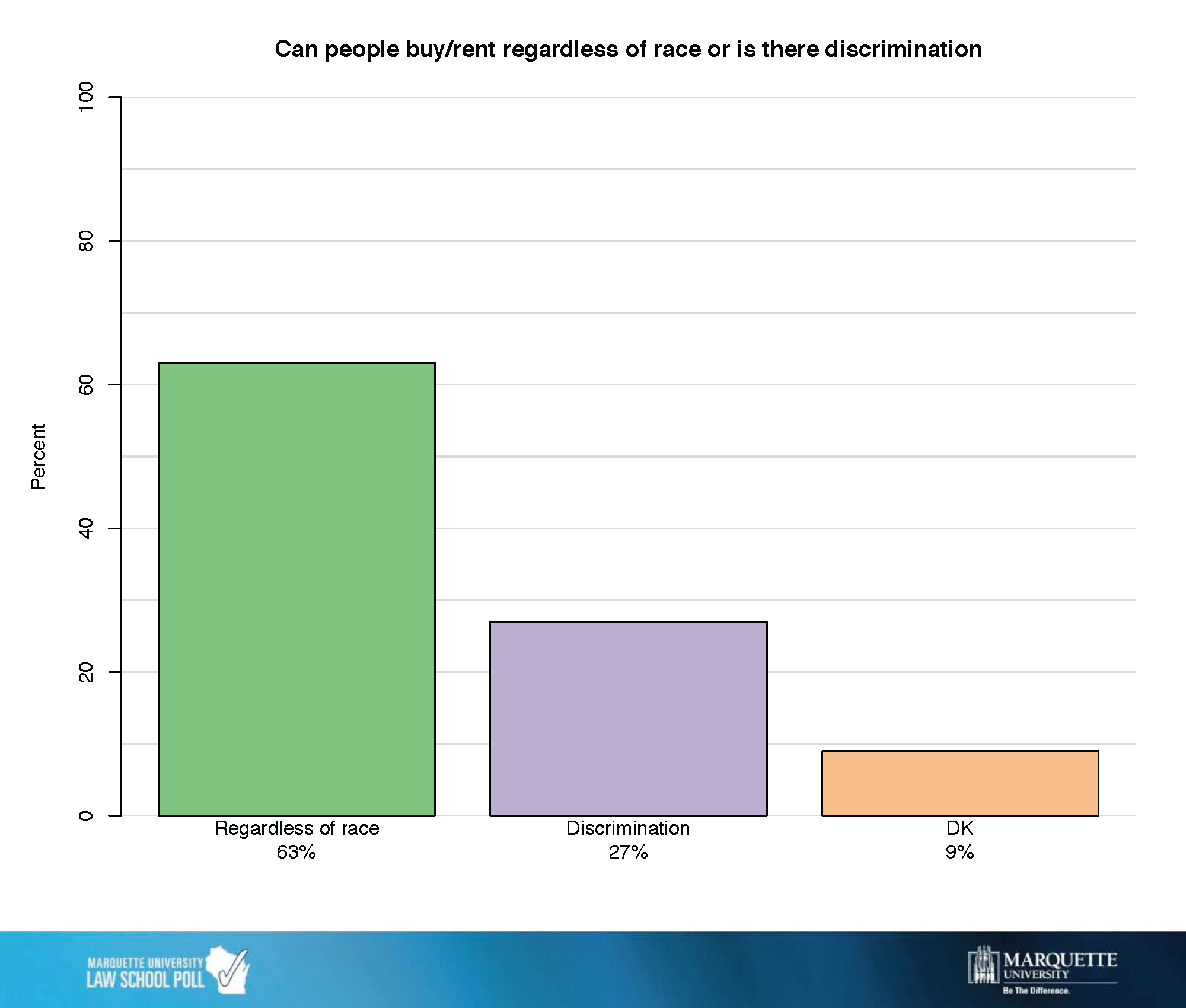
The Milwaukee Area Project’s debut poll asked respondents, “Do you think that people in your community have the opportunity to rent or purchase a home they can afford regardless of their race, or is there significant racial discrimination in housing?”

Displays the results of the Milwaukee Law School Poll's fair housing question by race/ethnicity

This question echoes a longer history in the Milwaukee area over access to housing. The winter of 2017-2018 marks the 50th anniversary of the “March on Milwaukee.” For two hundred consecutive nights, starting in September 1967, civil rights activists in Milwaukee marched to demand that people be allowed to buy and rent homes that they could afford without being subject to discrimination on the basis of race. At the time, it was legal for property owners to reject prospective renters or buyers because they were black.

Starting in May 1962, Alderman Vel Phillips (elected as Milwaukee’s first African American and first female city council member in 1956) proposed an ordinance that would have barred city property owners from discriminating against African Americans. Proponents of this kind of law in the United States said that it would ensure “fair housing” or “open housing”—in pointed contrast to housing that was unfair or closed. Opponents of the law, borrowing the rhetoric of “forced busing” from the contemporaneous debate about desegregation of public schools, decried what they called “forced housing.” Phillips’s ordinance was repeatedly offered and defeated by a vote of 18-1 in the years leading up to start of the marches.

Milwaukee’s open housing marches continued every night into mid-March 1968. In April, a week after the assassination of Rev. Dr. Martin Luther King, Jr., the US enacted the Civil Rights Act of 1968. This law, also known as the Fair Housing Act, outlawed racial discrimination in housing and other practices that hobbled African Americans’ search for decent homes. By the end of April, the Milwaukee Common Council followed suit with its own fair housing ordinance. The passage of fair housing laws, however, did not in itself end racial discrimination. In 1977, a new organization, the Metropolitan Milwaukee Fair Housing Council, was created in order to help people who faced illegal discrimination.

If you are interested in learning more about the history of open housing in Milwaukee, the sources below may be helpful.

Digital Resources

Entries posted in the Encyclopedia of Milwaukee illuminate local struggles over access to housing, including:

The award-winning digital archive March on Milwaukee Civil Rights History Project showcases primary sources from the archival collections of the University of Wisconsin-Milwaukee Golda Meir Library: http://uwm.edu/marchonmilwaukee/

If you would like to dig deeper, try the following books and articles:

  • Jack Dougherty, “African Americans, Civil Rights, and Race-Making in Milwaukee,” in Perspectives on Milwaukee’s Past, edited by Margo Anderson and Victor R. Greene, 131-61 (Urbana, IL: University of Illinois Press, 2004).
  • Patrick D. Jones, The Selma of the North: Civil Rights Insurgency in Milwaukee (Cambridge, MA: Harvard University Press, 2009).
  • Stephen Grant Meyer, As Long as They Don’t Move Next Door: Segregation and Racial Conflict in American Neighborhoods (Lanham, MD: Rowman & Littlefield, 2000).
  • Erica L. Metcalfe, “‘Future Political Actors’: The Milwaukee NAACP Youth Council’s Early Fight for Identity,” Wisconsin Magazine of History 95, no. 1 (2011): 16-25. http://content.wisconsinhistory.org/cdm/compoundobject/collection/wmh/id/50802/show/50759/rec/1
  • Margaret Rozga, 200 Nights and One Day (Hopkins, MN: Benu Press, 2009).
  • Margaret Rozga, “March on Milwaukee,” Wisconsin Magazine of History 90, no. 4 (2007): 28-39. http://content.wisconsinhistory.org/cdm/compoundobject/collection/wmh/id/49374/show/49373/rec/1

Master’s theses and dissertations also provide information on open housing not readily available elsewhere.

  • Liane Ardell Aylward Dolezar, “Father James E. Groppi: A Case Study of Civil Rights Rhetoric” (Master’s thesis, Speech and Dramatic Art, University of Nebraska-Lincoln, 1969).
  • Katelyn Barnes, “James Groppi: A Man and His Faith: A Biography” (Master’s thesis, History, University of Wisconsin-Milwaukee, 2011).
  • Thomas R. Feld, “The Rhetoric of Father James Groppi in the Milwaukee Civil Rights Movement: A Study of the Rhetoric of Agitation” (Master’s thesis, Speech, Northern Illinois University, 1969).
  • Erica L. Metcalfe, “‘Coming into Our Own’: A History of the Milwaukee NAACP Youth Council, 1948-1968” (MA thesis, University of Wisconsin-Milwaukee, 2010).
  • Julius John Modlinski, “Commandos: A Study of a Black Organizations’ Transformation from Militant Protest to Social Service” (PhD. Diss, Social Welfare, University of Wisconsin-Madison, 1978).
  • Jay Anthony Wendelberger, “The Open Housing Movement in Milwaukee: Hidden Transcripts of the Urban Poor” (Master’s thesis, University of Wisconsin-Milwaukee, 1996).

For the deeper background of African Americans in Milwaukee, see:

  • Joe William Trotter, Jr., Black Milwaukee: The Making of an Industrial Proletariat, 1915-45 (Urbana, IL: University of Illinois Press, 2006; originally published 1985).


Continue ReadingOpen Housing