Garner’s Tips on Editing Sentences

Posted by:
Category: Legal Practice, Legal Writing, Public
Leave a Comment »

One of my students, Drew Walgreen, recommended this article by Bryan A. Garner, published originally in the Michigan Bar Journal.  Bryan Garner, if you haven’t already heard, is a noted legal writing specialist and author who has written books such as Legal Writing in Plain English.  This article focuses on twenty common mistakes lawyers make when editing sentences.  I like that the article gives an example of each mistake and the corrected version.

Print Friendly


Keats and the Lawyer

Posted by:
Category: Legal Writing, Public
3 Comments »

KeatsA few months ago, I pulled the Norton Anthology of English Literature from my bookshelf—an old friend to read on a cold winter day. The page fell open to Keats, and a reference to Richard Woodhouse, barrister and friend of Keats, caught my eye.

John Keats (1795-1821) was an English Romantic poet. Keats wrote for six years before he died of tuberculosis in Rome at age 25. During that short time, he created some of the most beautiful verse, such as his sonnet, “On First Looking into Chapman’s Homer” (1816):

Much have I travell’d in the realms of gold,
And many goodly states and kingdoms seen;
Round many western islands have I been
Which bards in fealty to Apollo hold.
Oft of one wide expanse had I been told
That deep-brow’d Homer ruled as his demesne;
Yet did I never breathe its pure serene
Till I heard Chapman speak out loud and bold:
Then felt I like some watcher of the skies
When a new planet swims into his ken;
Or like stout Cortez when with eagle eyes
He star’d at the Pacific–and all his men
Look’d at each other with a wild surmise–
Silent, upon a peak in Darien.

Richard Woodhouse was an English barrister who represented Keats’ publisher, Taylor and Hessey. Keats and Woodhouse became friends, and Woodhouse encouraged Keats in his writing. Keats was to receive an inheritance when he turned 21, but he did not know of the inheritance. As such, Keats struggled for want of money, and his publisher gave him an advance on his second book. To me, Woodhouse had a unique view of Keats that came in part from Woodhouse’s work as a lawyer: Woodhouse, as a lawyer, was able to evaluate Keats both professionally and personally, and he recognized Keats’ talent.

Read more »

Print Friendly


ADHD and Keeping Time in Practice

Posted by:
Category: Legal Practice, Legal Writing, Public
2 Comments »

alarm-clockEach spring semester, when my first-year writing students have moved from objective writing from pre-selected authorities to persuasive writing and doing their own research, I have them keep track of their time. In law practice, time is money.  Even if a lawyer does not bill her hours to a client, she is likely still required to keep track of their time, if only for that organization’s internal purposes. For better or for worse, practicing attorneys must know well each .1 of an hour they work, on what, and for whom.

The time-keeping exercise is designed to provide students practice with billing their time, learning, for example, how to convert, say, twenty minutes of reading cases to .3 of research.  It’s also an exercise designed to give them practice on what kinds of activities to bill. The time spent online looking for case law? Yes.  The writing of the brief?  Of course.  But what about that one-hour meeting with the professor?  Sure.  I’d call that an office conference and lawyers have those all the time. 

After students have finished their first briefs and have turned in their time sheets, I have them reflect on keeping time and ask them what they learned from the exercise. Most students aren’t fond of the exercise, but do recognize its value. One student once asked why I couldn’t ask them to keep track of their time in “normal” increments, like .25, .50, .75, and 1.00. This year, one student responded that keeping time was, for him, incredibly painful.  You see, he said, he has Attention-Deficit, Hyperactivity Disorder (ADHD). Read more »

Print Friendly


Celebrating Poetry

Posted by:
Category: Legal Practice, Legal Writing, Media & Journalism, Political Processes & Rhetoric, Popular Culture & Law, Public
Leave a Comment »

wordsApril is National Poetry Month, which may be Marquette University President Scott R. Pilarz, S.J.’s favorite month.  And for good reason.  Poetry can sometimes say what we can’t; it can touch our hearts and our souls with its inspiration, its longing, its joy, and its sadness.

Last year, on this blog, several of us wrote about poetry, sharing our favorites, composing new poetry in both traditional and different ways, or exploring poetry in and about the law.  As student Gabe Houghton noted this post, there are some judges who compose opinions in verse.

As April closes, I just wanted to remind everyone that poetry should be celebrated all months and remember that there are many kinds of poetry.  Songs can be considered poetry set to music. There are also poetry slams.   My favorite in this last genre is Taylor Mali, teacher and poet.  You can see him perform his poem “Totally like whatever, you know?” here.  It’s a nice reminder for those of us who love language that what we say, as well as how we say it, matters.

Print Friendly


Congratulations to the 2013 Jenkins Honors Moot Court Competitors

Posted by:
Category: Legal Writing, Marquette Law School, Public
Leave a Comment »

The Jenkins Honors Moot Court Competition is an appellate moot court competition for Marquette law students. Students are invited to participate based on their performance in the fall Appellate Writing and Advocacy course at the Law School.

Congratulations to the participants in the 2012 Jenkins Honors Moot Court Competition:

Todd Allen
Michael Beckman
Codi Carstens
Kelly Cavey
Nicholas Chmurski
Stephen Cox
Michael Crane
Alexander Golubiewski
Andy Gordon
Krystal John
Kevin Jolivette
Paul Jonas
Brittany Kachingwe
Hans Lodge
Tea Norfolk
Kerri Puig
Kaitlyn Reise
Brendon Reyes
Jessica Shank
Joy Sisler
Martin St. Aubin
Robert Steele

Students will begin writing their appellate briefs in January with the rounds of oral argument commencing later this spring. The competition includes three preliminary oral argument rounds and a semifinal and final round.

The Jenkins competitors are fortunate to have the opportunity to argue before distinguished members of the bench and bar from Wisconsin and beyond.

The competition is named after the James G. Jenkins, the first Marquette Law School dean.

Print Friendly


Marquette Moot Court Team Success at the NMCC

Posted by:
Category: Legal Writing, Marquette Law School, Public
Leave a Comment »

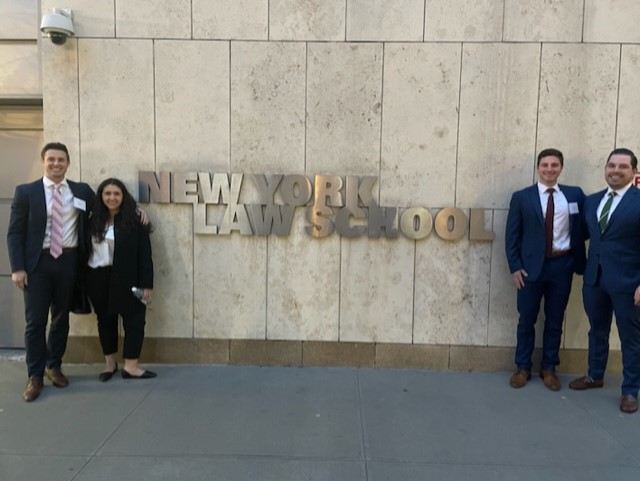
I had the privilege of working with two outstanding National Moot Court Competition (NMCC) teams again this year. The Region VIII round of the NMCC was hosted by Marquette this weekend.

Please congratulate team members Joseph Birdsall, Nicole Cameli, and Patrick Ritter, who advanced to the semifinal round of competition (top four teams out of 18). The team additionally received the second highest brief score at the competition. Attorneys Emily Lonergan and Jason Luczak coached the team.

Please also congratulate team members Steven Miracle, Megan Mooney, and Ariane Strombom for their performance at the competition. The team advanced to the quarterfinals (top eight teams). Attorneys Jesse Blocher and Michael Cerjak coached the team.

The NMCC is sponsored by the New York City Bar and the American College of Trial Lawyers. Over 150 law schools compete across the country.

I am grateful for our teams’ hard work; they put in many hours of practice to prepare for the competition. I am also grateful for the time donated by the Marquette Moot Court Association and many judges and lawyers who judged the briefs and oral arguments for our NMCC regionals. Finally, thank you to the individuals who judged the teams’ numerous practice rounds.

Print Friendly


Inherently Subversive Pedagogy

Posted by:
Category: Constitutional Law, Education & Law, Legal Education, Legal Writing, Public, Race & Law
4 Comments »

In 2010 the Arizona legislature created a law designed to deter the teaching of a Mexican American Studies course in Tucson schools by cutting State funding to districts with courses that, among other things, “promote resentment toward a race or class of people.”  After a finding by the state court in 2011 and under the threat of a $15 million fine, the Tucson district was forced to stop utilizing a course that was available to all students, was effectively closing the achievement gap, and was successful in helping Latino students attend college.  One aspect of enforcement that the district decided on was banning the use of many books that were a part of the Mexican American Studies program from schools.

I was introduced to the Tucson curriculum issue in Professor Mazzie’s first semester Legal Analysis, Research, and Writing 1 class last fall.  Our assignment was to write a brief memo on whether the Tucson course was in violation of A.R.S. § 15-112.  The constitutionality of the Arizona law itself has since been called into question under the purview of a federally appointed special master who is overseeing the Tucson School District’s mandated desegregation.  It was satisfying to see, earlier this month, the U.S. Court of Appeals for the Ninth Circuit agree with my position in Professor Mazzie’s class that the curriculum was not necessarily a per se violation of A.R.S. § 15-112 anyway. Read more »

Print Friendly


So You Think Grammar Don’t Matter?

Posted by:
Category: Legal Education, Legal Practice, Legal Writing, Public
4 Comments »

We all know its a tight job market out their.  So you got to make sure you set yourself a part from other applicants.  One way to do this is to spend alot of time working threw ur resume and cover letter making sure they say what you want them to say and so that they convey the rite image of you.

And if your cover letter or email to an employer looks or sounds anything like the above paragraph, you can be assured you won’t get an interview, much less get hired, especially at Kyle Wiens’ business.  Why?  Wiens won’t hire anyone who doesn’t care about grammar. Read more »

Print Friendly


Reading and Briefing Cases Part 2

Posted by:
Category: Legal Writing, Public
Leave a Comment »

Reading and briefing cases is an important part of the learning process in law school, as discussed in Part 1 of this blog series. In this blog, various Marquette legal writing faculty discuss some of their favorite tips for effective reading and briefing.

Professor Rebecca Blemberg

When you have finished reading a case, write down the question or questions the court answered. Then fill in the blanks in this sentence: The court held _______________ because ________________. Even if you’re not entirely sure what the court’s reasoning was, make an educated guess. Then consider the following. Was the court explicit in its reasoning? If so, mark or highlight the explicit rationale for the holding. Is the reasoning implicit? If so, mark or highlight the places where you find the court hinting at its rationale. Are you making an educated guess or “reading between the lines” to find the court’s reasoning? If so, make a list of a few reasons for your educated guess. The reasons can be related to the facts of the case, public policy, language choices by the court, the court’s use of authority, etc.

Look up every unfamiliar word you encounter in a case, especially legal terms. Read with access to a law dictionary. Eventually, you will look up terms far less often.

Professor Jacob Carpenter

One piece of advice I would consider is to read a case at least twice, briefing it only after you’ve fully read it at least once. This may not be as necessary for upper-level students, but for 1Ls, I think it is important. Otherwise, if a person briefs a case as she first reads it, the brief often ends up including extraneous facts and dicta that aren’t helpful to the brief. Once the reader finishes reading the case, the reader often has to go back and cross out chunks of information initially included in the brief. And, the brief often ends up being disorganized. This may be less of a problem now that most students brief cases with their laptops instead of by hand. But, I think it is still helpful.

Also, waiting to brief the case until you’ve already read it allows you to focus more on understanding the case itself during the first read, and then during the second read you can focus on getting the crucial information down into your brief in an organized, concise way. I also think it helps you remember the case better when called on in class or when revisiting the case as you prepare outlines later in the semester.

Read more »

Print Friendly


Lawyering on the Right Side of the Brain

Posted by:
Category: Legal Practice, Legal Writing, Public
Leave a Comment »

There has been quite a bit of news lately on neuroscience and the law. The Law and Neuroscience Blog specifically focuses on the topic, discussing everything from lying to U.S. Supreme Court decisions which cite neuroscience research. This trend enhances the right brain vs. left brain discussions that have been around for decades. While modern technology is challenging some of those assumptions, recent studies have taken the right brain vs. left brain discussion into politics. Right brain functions are typically identified as more creative, while the left side of the brain is often identified with analytical skills, logic, and other functions one might typically associate with skilled lawyers.

This blog post from the ABA showcases a lawyer who tapped into both sides of his brain and filed a cartoon amicus brief opposing a price-fixing settlement between the DOJ and three e-book publishers. While in the end the federal judge approved the settlement, she quoted Emily Dickinson in the ruling.

Curious about your own right brain/left brain tendencies? There are many tests on the web; this test from the Art Institute of Vancouver provides a detailed analysis focused on creativity. Want to tap into your creative side? Try Drawing on the Right Side of the Brain by Betty Edwards.

Print Friendly


Reading and Briefing Cases in Law School

Posted by:
Category: Legal Writing, Public
1 Comment »

In my first semester of law school, a very smart friend came to visit me for a few days. I handed her a case from my legal writing problem set and asked her to read the case. She could barely make any of it out. I felt significantly better about myself, for I had been wondering if I had forgotten how to read.

I think this feeling is common in the first few weeks or months of law school. Reading the law for the first time can be disorienting for several reasons, including the foreign terminology, the new structure of the cases, and the lack of context. Translating the written text into something that makes sense and then being able to communicate that material orally in class is a difficult skill to master for new law students.

If reading and briefing cases are skills that a student would like to strengthen, I recommend Ruth Ann McKinney’s book Reading Like a Lawyer: Time-Saving Strategies for Reading Law Like an Expert. The book starts with the premise that being an “expert reader” is a pre-requisite to excelling in law school and in the practice of law. The book goes on to tackle both reading and briefing cases with concrete strategies for both.

Read more »

Print Friendly


New Bluebook Mobile App

Posted by:
Category: Legal Practice, Legal Scholarship, Legal Writing, Public
1 Comment »

The Bluebook, A Uniform System of Citation, fondly referred to as “The Bluebook,” is now available as a mobile app. The Bluebook is a legal citation style guide. The app is available for sale through the rulebook app on all Apple iOS devices.

On August 22, 2012, the Federal Rules of Appellate Procedure, Bankruptcy Procedure, Civil Procedure, Criminal Procedure, and Evidence may be downloaded for free on the rulebook app.

Print Friendly