Milwaukee traffic accidents reach a new high in 2019, growing 65% since 2011

A recent article by the Wisconsin Policy Forum details a disturbing increase in auto deaths among Wisconsin African Americans.

From 2013 to 2018, the motor vehicle crash fatality rate for black, non-Hispanic Wisconsinites nearly doubled on an age-adjusted basis, according to data from the federal Centers for Disease Control (see Figure 1). In raw numbers, motor vehicle deaths for black Wisconsinites increased from 31 in 2013 to 39 in 2014, 56 in 2015, and 62 in 2016. They hit a high of 79 in 2017.

This trend in fatal crashes coincides with a significant and ongoing increase in the total number of traffic accidents occurring in the City of Milwaukee. In 2011, MPD reported 10,616 accidents. By 2019, this had risen to 17,568.
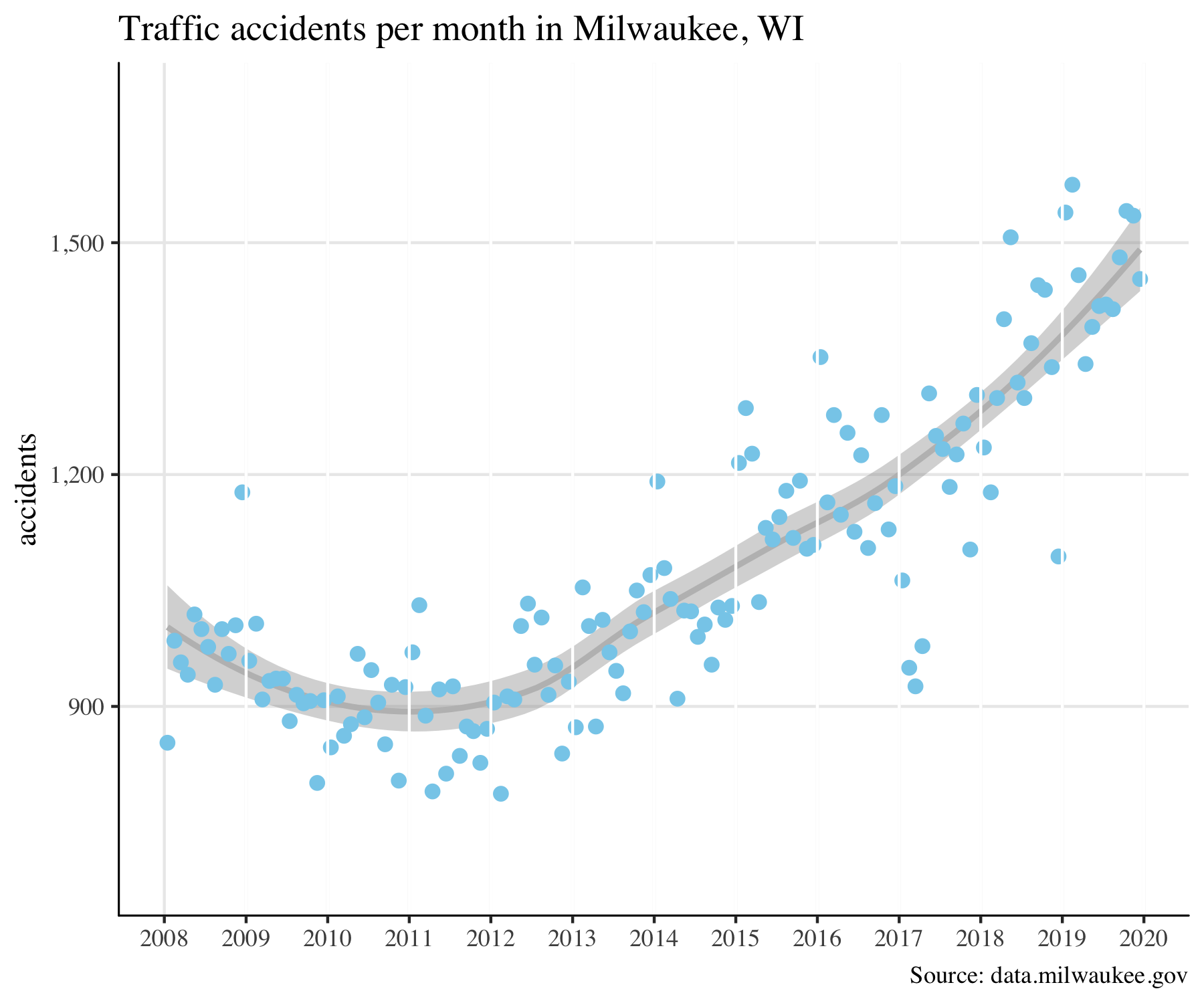
Traffic accidents by month

Accidents have increased uniformly across every hour of the day and each day of the week. Sunday consistently has the fewest accidents and Friday has the most. In 2011 there were 26 accidents on the average Sunday and 32 on a normal Friday. In 2019 the average Sunday had 42 accidents; Fridays had 53.
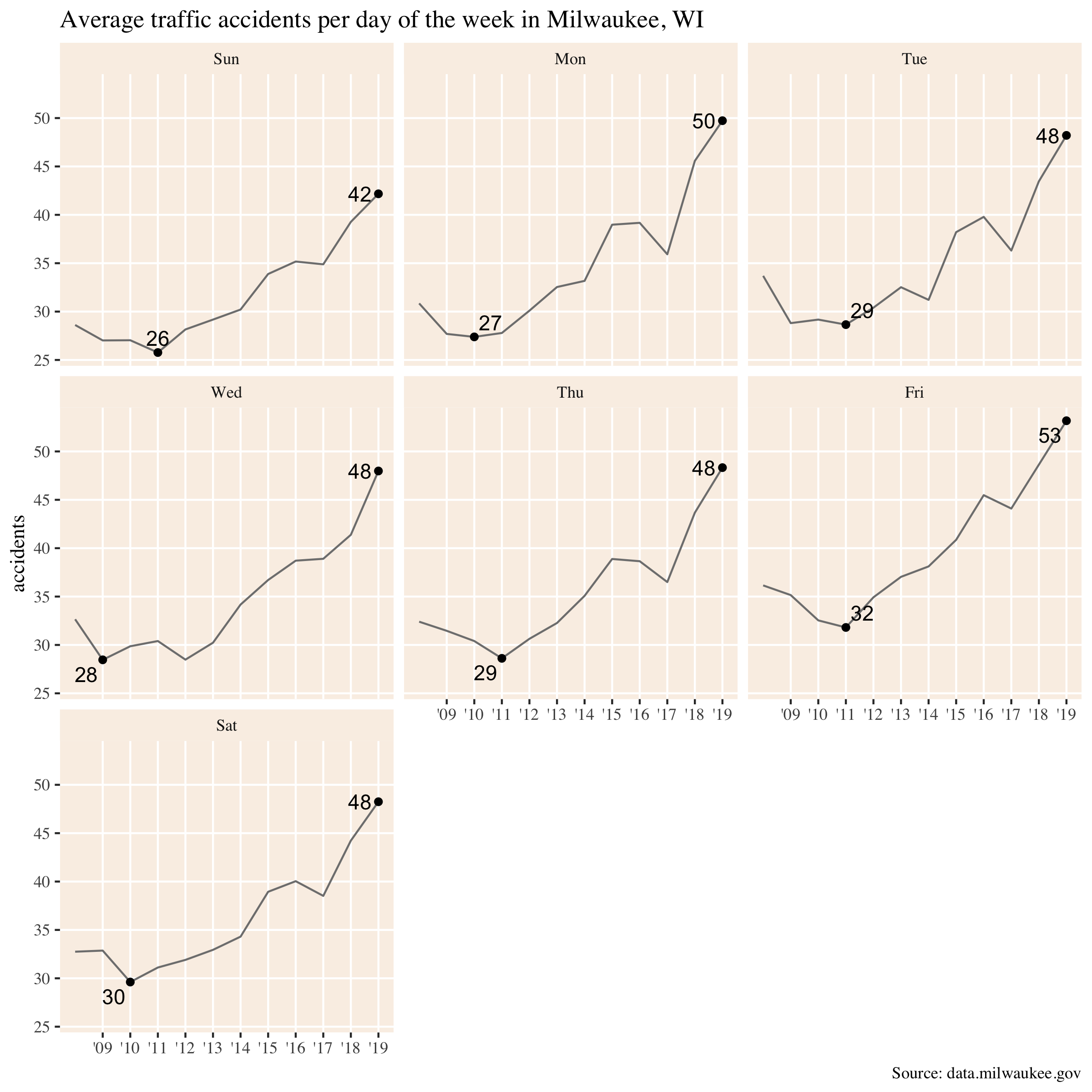
average traffic accidents by day of the week

The afternoon rush hour (4-5pm) causes the most accidents. 781 accidents occurred during these 60 minutes in 2011. In 2019, 1,379 did.

Every hour of the day saw double-digit percentage increases in traffic accidents from 2011 to 2019. But the wee hours of the morning underwent the smallest jumps, while the late afternoon and early evening experienced the biggest. Accidents from 2 to 3am increased 15%; they surged 98% during the 8pm hour.
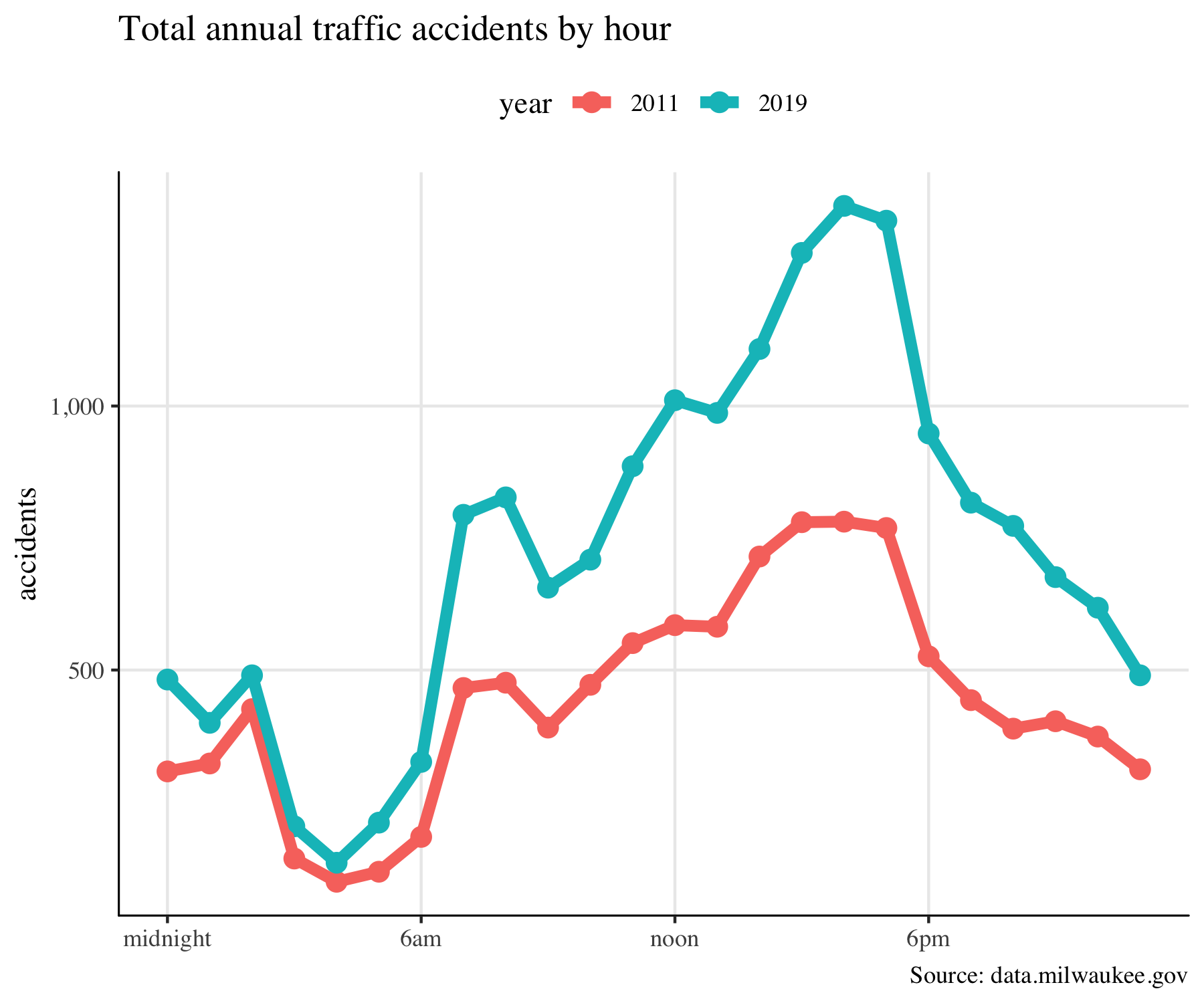
Total annual traffic accidents by hour


The data in this post is from this City of Milwaukee dataset. It was downloaded on February 25,  2020. Reportable traffic accidents include all incidents causing either (1) injury or death, (2) least $200 of non-vehicle damage to government property, or (3) at least $1,000 of damage to any one person’s property.

Continue ReadingMilwaukee traffic accidents reach a new high in 2019, growing 65% since 2011

A Retrospective on the “Year of Clean Drinking Water”

2019 was a memorable year for those interested in Wisconsin’s water resources. During his January 2019 “State of the State” address, Governor Tony Evers declared it the “Year of Clean Drinking Water in Wisconsin,” making water a primary focus of his first year in office. Around the same time, Assembly Speaker Robin Vos announced the creation of a water quality task force to study water contamination issues. Shortly thereafter, I An exterior photo of the Wisconsin State Capitol.wrote a post describing a shorthand “top ten” list of issues for the administration and the task force to consider. In no particular order, my list included lead laterals, PFAS and other emerging contaminants, nutrient pollution, groundwater contamination and private wells, Great Lakes diversions, CAFO regulation, the DNR, infrastructure, high capacity wells and groundwater drawdown, and wetlands protection.

But now 2020 has arrived. What were the tangible results of the “Year of Clean Drinking Water”? Many promising efforts are underway and the state has made significant progress in some areas, but much remains to be done. The Governor’s declaration and the Speaker’s task force brought much needed public attention to water quality issues, but it would be a shame if that intense focus fades with the turning of the calendar. Governor Evers recognizes this, admitting in a recent interview that he knows the work will take much more than a year. And he expects Wisconsinites to support it in the longer term: “People like to have clean drinking water,” he said. “Who doesn’t want it? Who doesn’t need it?” Yet in his 2020 “State of the State” address Evers mentioned water only once, a late reference to “getting PFAS out of our water” as part of a list of things yet to be accomplished.

Here are the specifics of what happened last year:

Continue ReadingA Retrospective on the “Year of Clean Drinking Water”

Climate Responsiveness at a Local Scale

We often focus on the international level when discussing responses to climate change—for example, the just-concluded 25th Conference of the Parties to the United Nations Framework Convention on Climate Change, the ongoing struggle to operationalize the Paris Agreement, or even the war of words between President Trump and young Swedish activist Greta Thunberg.

A photo of Earth, taken from space.But a much wider spectrum of entities and organizations will have to conduct adaptation and mitigation measures to respond to the intensely local impacts of a changing climate. Among these are what used to be known as wastewater treatment utilities—now often called water reclamation facilities—that may have to deal with (among other things) predicted widespread flooding dangers caused by an increase in larger, more intense precipitation events.

For years, the Milwaukee Metropolitan Sewerage District has been recognized as a “green leader” on a number of fronts, including climate change preparedness. The Marquette University Water Law and Policy Initiative received funding through the MMSD-Marquette WaterCARE grant program to examine and benchmark the District’s considerable climate progress against federal guidance, against actions taken by six peer utilities, and against the ambitious goals it has set for itself (the District seeks, by 2035, to meet 100% of the District’s energy needs with renewable sources, including 80% from internally generated sources, and to reduce its carbon footprint by 90% from its 2005 baseline). Earlier this month, the Initiative completed its work and issued a final report to the District.

Continue ReadingClimate Responsiveness at a Local Scale