The Uninvited
The recent discovery of a voracious, non-native aquatic predator only nine miles from Lake Michigan is alarming but not particularly surprising, in light of the unappealing options for legal and political responses. However, when coupled with policy and budget changes implemented by the Trump administration, the new find may reignite a series of legal battles between the Midwestern states that the Seventh Circuit has dealt with twice in the past six ye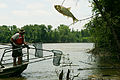 ars. First, the factual background: Asian carp (shorthand for several species including grass carp, bighead carp, silver carp, and black carp) eat up to 20% of their weight per day and grow to several feet long and over one hundred pounds. Videos document their tendency to leap out of the water when startled, sometimes colliding with boaters and causing injury or damage. They have no natural predators and, by some estimates, would wreak havoc on the Great Lakes food chain and devastate the multi-billion dollar Great Lakes fishery. In 2006 the U.S. Fish and Wildlife Service estimated that “Asian carp pose the greatest immediate threat to the Great Lakes ecosystem.”
The story of the carp’s inexorable march to the doorstep of the Great Lakes is both a lesson in the law of unintended consequences and a cautionary tale of political and legal inefficacy. Beginning in the 1960s, southern fish farmers imported several species of carp to control vegetation in ponds. The carp entered the lower Mississippi River basin via accidental releases and flooding events, and have since rapidly migrated through nearly the entire basin, with their populations increasing exponentially. Even so, the carp could not have threatened the Great Lakes without the artificial connection between the Mississippi and Great Lakes basins created by the City of Chicago in the year 1900, which was originally constructed as a crude sewage treatment solution but now serves other purposes.
The Obama administration made some efforts to control the spread of the carp, and especially to keep them out of the Great Lakes. In 2010, the president convened a “carp summit” at the White House and appointed an “Asian carp czar” who led an effort to eradicate them. President Obama also proposed a $78 million plan to improve the federal response to the issue. Later, the United States Army Corps of Engineers developed a four-pronged strategy to prevent carp from becoming established in the Great Lakes, including the construction and operation of a large electric dispersal barrier between the Chicago Sanitary and Ship Canal and the entry to the Great Lakes. And the Wisconsin Department of Natural Resources recently developed a “Response Framework for Invasive Species,” which addresses invasive aquatic species without specifically mentioning the carp. None of these well-meaning efforts has successfully halted the carp’s progress.
The Trump administration has taken a different approach that may run afoul of two recent Seventh Circuit decisions and lead to additional legal maneuvering.