
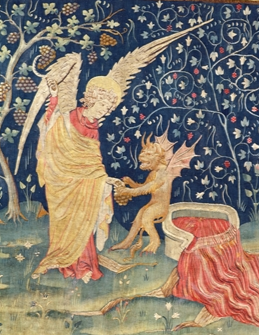
The Grapes of Roth

My latest article, “The Grapes of Roth,” has just come out in print in the Washington Law Review. In it, I argue that copyright law passed through at least three important phases over the course of the last century, in which judges struggled in different ways with the process of how to determine whether two works are infringing. This periodization of copyright decision-making is, I believe, insufficiently appreciated; copyright lawyers, scholars, and students tend to read cases from any era as going about the decision-making process in the same way. The goal of the article is to focus more attention on how decision-making has varied over time, and to at least begin the discussion of which era’s procedure is closer to optimal.

The title is a reference to the old copyright chestnut Roth Greeting Cards v. United Card Co., in which the majority concluded that infringement was the right call based on the shared “total concept and feel” of the plaintiff’s and defendant’s greeting cards. The “total concept and feel” standard from Roth is one that copyright lawyers love to hate. The phrase is nearly meaningless: concepts are explicitly excluded from protection under 17 U.S.C. § 102(b), and copyrighted works are distinct from any physical embodiment, meaning they have no “feel.” The influential Nimmer treatise has for decades reproached the standard as “invit[ing] an abdication of analysis.”

So why is it so popular? Judges seem to have no qualms about using it, no matter what the commentariat says. They have cited it regularly as the standard for infringement in cases involving non-identical works from the 1980s to the present day. Indeed, it has found its way into jury instructions: juries are commonly told, without further elaboration, that two works are infringing if one was copied from the other and they share the same “total concept and feel.” The answer to this puzzle, I argue, sheds light on the transition from the first phase to the second, and reveals the trap sprung (or the “grapes” pressed) in the third.

Over the next several days I’m going to serialize the article here. I’ll cover in somewhat less detail (but with more images!) the three historical phases I identify, and then wrap up with a concluding post on whether those phases are limited to copyright law.
Continue ReadingThe Grapes of Roth

The Face of the Case: Obergefell Tells How He Became Part of Legal History

James Obergefell grew up in a blue collar, Catholic family in Sandusky, Ohio, got an undergraduate degree from the University of Cincinnati, and became a high school teacher.

“I was deep in the closet,” he said as he told his story during a program Wednesday, Sept. 18, 2024, in the Lubar Center at Marquette Law School. He came out in the early 1990s while he was in graduate school and met John Arthur. Within a short time, they considered themselves married. Legally, they were not – at the time, same sex marriage was not legal anywhere in the United States. But beginning in the mid -990s, they decided they wanted “marriage and everything that came with it,” as Obergefell put it.

Obergefell told Derek Mosley. executive director of the Law School’s Lubar Center for Public Policy Research and Civic Education, who moderated the conversation before a capacity audience of more than 200. how the legal landscape began to change, including a US Supreme Court decision in 2013 that struck down a federal law known as the Defense of Marriage Act. During the same period, Arthur’s health declined sharply after being he was diagnosed with ALS in 2012.

After the Supreme Court decision, Obergefell and Arthur decided to get married. Because Arthur’s health was so precarious, they needed to act quickly. And because legalities involving marriage varied across the country, they ended up taking a medical ambulance flight to the Baltimore/Washington airport in Maryland, where they could have a ceremony without ever getting off the airplane. Three months later, Arthur died.

What emerged from their marriage was a court case focused on whether Obergefell was the surviving spouse legally. And that case was joined with similar cases that ended up before the US Supreme Court, resulting in the landmark decision of Obergefell v. Hodges in 2015 which made same sex marriage legal throughout the United States. Obergefell recounted the events of the day the Supreme Court decision was issued. “I burst into tears” in the courtroom, he said. “For the first time in my life as an out gay man, I felt like an equal American,” he said. The audience applauded when he said that.   

Obergefell’s name became a big part of American legal history. And Obergefell himself moved from being a person of no prominence and no notable involvement as an activist into a continuing spotlight. It made him, as Mosley put it at the Law School program, “the face of the case,” someone who continues to be an advocate for rights of many kinds and someone who tells his personal story openly and with impact. Obergefell said he has realized how “stories matter — stories can change hearts and minds.”

“Going through something like this has a profound impact,” Obergefell told the audience. “It changes you.”

Obergefell said he is still motivated by anger over things he sees as wrong and the need to advocate for the rights of people facing many different situations. He also has less intense involvements, such as co-owning a wine label that has raised more than $250,000 for causes supported by him and the co-owner.

“Nothing makes me happier than to know that young people today are growing up in a world where the question of their right, their ability, to get married and have that relationship recognized is there.” Obergefell said.  “I had the absolute honor and privilege of being part of making things better for people younger than I am.”

Video of the one-hour program may be viewed by clicking below.

Continue ReadingThe Face of the Case: Obergefell Tells How He Became Part of Legal History

Remembering a Marquette Lawyer (and Judge) on the Centennial of His Birth

Tom Curran A week and a half ago, the Law School held our annual Alumni Awards Reception and Conferral—always a highlight of our year. For it enables us to celebrate Marquette Law School’s spirit and ideals by recognizing four exemplars of the genus (or perhaps it’s the species) of the Marquette lawyer.

I had occasion that day to talk with a longtime colleague about past such alumni awards receptions and conferrals, including the one in 2007, where we honored Martin J. Greenberg, L’71, with the Charles W. Mentkowski Award for the Sports Law Alumnus of the Year; (now-Judge) Katie Maloney Perhach, L’00, with the Howard B. Eisenberg Service Award; the Hon. Patricia J. Gorence, L’77, as the Alumnus/a of the Year; and the Hon. Thomas J. Curran, L’48, with the Lifetime Achievement Award. Then, last week, my colleague noted to me that today would have been the 100th birthday of the last of these individuals (the other three, happily, still being active alumni). I relate a brief story about Judge Curran here.

I recall my commendation of him on that occasion in 2007. I said in part this:

You may think that it is his service for almost a quarter-century as United States District Judge here in Milwaukee that recommends [Tom Curran] for this award. And this is relevant, for it is a lifetime achievement award. I am inclined to think, though, that Tom Curran would be receiving this award even if he had never become Judge Curran, for his accomplishments from 1948 to 1983 would have sufficed.

Tom Curran joined his brothers’ law firm in Mauston, Wisconsin, in 1948, and for a brief moment—a year or so—the firm was Curran, Curran & Curran. That did not last, not I am sure because of any difficulty on the part of Irish brothers in getting along with one another, but because one of his brothers left in 1950 to become a circuit judge in Juneau County, where he served for the next 30 years. The firm flourished nonetheless, and today it is one of the largest firms in the state outside of a major metropolitan area (with apologies to the many Currans and others here today from Mauston for my characterization).

Of course, the fact that there are several Currans at the firm still (Judge Curran’s children) does contribute to the numbers somewhat, but you cannot maintain a firm of this size—or even stay in business for so long—without developing a reputation for quality and trustworthiness, and the Curran firm surely has that reputation. And much of that reputation developed during Tom Curran’s 35 years of practice in Mauston.

His own stature as a lawyer meant that Tom Curran was elected by his statewide peers to the presidency of the State Bar of Wisconsin, a signal honor.

I said more, but let me move the story along. I also recall a portion of Judge Curran’s remarks in then accepting the Lifetime Achievement Award:

Given the very special place Marquette already had in the lives of the Currans, it was no surprise, when I was discharged from the Navy in July 1946, that I would come up and enroll at Marquette. And I found myself, four days later, sitting in a classroom, as we then had the three-semester-a-year program, given that probably 95 percent of us were veterans. I would guess that we ranged in rank from a private to a brigadier general—a former brigadier general. The only problem was that the general had trouble remembering the “former” part of it—or at least he did, for maybe two or three weeks, until he ended up in Professor Ghiardi’s class.

Finally, I recall but, alas, cannot directly quote the moment in his acceptance remarks—not scripted, I should think—where Judge Curran turned around from the podium and looked back at Rev. Robert A. Wild, S.J., then the president of Marquette University, and me.

Judge Curran noted the coincidence of two guys from the South Side of Chicago leading a beloved Wisconsin institution, and his remarks were most generous. This was characteristic of Judge Curran, in my experience: he made that moment not about himself but about others—and about Marquette.

I have never forgotten it or him. It is pleasant to remember a generous and gracious Marquette lawyer and judge both on his 100th birthday and on other occasions.

Continue ReadingRemembering a Marquette Lawyer (and Judge) on the Centennial of His Birth